
Right now, a quiet revolution is unfolding across Australian art studios, galleries, and coastal workshops—one that challenges everything we thought we knew about modernism. While European and American artists dominated twentieth-century modernism with their established movements and rigid manifestos, Australian artists are dismantling those very structures, forging a distinctly antipodean interpretation that refuses to be confined by northern hemisphere definitions. This isn’t simply about geographic difference; it’s about fundamentally rethinking what modernism can be when freed from its European constraints and reimagined through the lens of unique landscapes, Indigenous perspectives, and a cultural identity that exists simultaneously at the world’s edge and its creative frontier.
Australian artists are redefining modernism by rejecting the European notion that abstraction must abandon representation entirely. Instead, they’re creating a hybrid visual language where abstraction serves landscape, where colour fields evoke coastal light, and where geometric forms echo native flora rather than industrial machinery. This approach doesn’t dilute modernism—it expands it, proving that the movement’s core principles of innovation, experimentation, and contemporary relevance can thrive without adhering to prescriptive formulas developed in Parisian studios or New York lofts. The result is a body of work that feels simultaneously global and unmistakably Australian, speaking to international audiences while remaining deeply rooted in local experience.
Key Takeaways
- Australian artists are creating a hybrid modernism that combines abstraction with representational elements drawn from local landscapes and native flora.
- The integration of Indigenous spatial concepts and connection to Country is fundamentally altering how contemporary Australian artists approach composition and meaning.
- Coastal light conditions unique to Australia are inspiring new approaches to colour field painting and atmospheric abstraction that challenge European colour theory.
- The absence of a dominant prescriptive art establishment has allowed Australian modernism to develop organically, prioritising individual vision over movement loyalty.
- This redefined modernism translates exceptionally well to contemporary interiors, offering sophisticated abstraction that maintains emotional warmth and contextual connection.
The European Modernist Template: Why Australia Never Fit
European modernism emerged from specific historical conditions—industrialisation, urbanisation, and the trauma of two world wars—that simply didn’t resonate the same way in Australia. The continent’s vast, ancient landscapes and relatively recent colonial settlement created a cultural context where the European imperative to “make it new” felt somewhat beside the point. How do you embrace the machine age aesthetic when your primary visual reference points are eucalyptus forests older than human civilisation? How do you adopt the urban fragmentation of Cubism when your cities exist as small pockets surrounded by thousands of kilometres of uninterrupted terrain?
This disconnect wasn’t a deficit—it was an opportunity. While mid-century Australian artists initially attempted to import European modernist styles wholesale, the results often felt derivative and disconnected from lived experience. However, contemporary Australian artists have stopped apologising for this mismatch and instead embraced it as creative license to cherry-pick elements that serve their purposes while discarding prescriptive dogma. They’ve recognised that the strict boundaries between abstraction and representation, between modernist purity and narrative content, were always artificial constructs rather than natural laws.
The tyranny of European validation no longer holds the same power it once did. Australian artists working today understand that international recognition doesn’t require mimicking northern hemisphere aesthetics. In practice, this manifests as work that confidently incorporates local subject matter—coastal formations, native botanicals, outback colour palettes—into thoroughly contemporary abstract frameworks. The result challenges the very notion that modernism must look a certain way to be legitimate, suggesting instead that modernism’s true legacy is the permission to innovate rather than any specific formal solution.

Moreover, the Australian art market’s structure has inadvertently supported this independence. Without the concentration of powerful galleries and critics found in Paris, New York, or London, Australian artists developed through a more decentralised system where regional variations and individual voices could flourish without immediate pressure to conform to a single dominant aesthetic. This created an environment where experimentation wasn’t just tolerated but necessary, as artists couldn’t simply replicate what was selling in overseas markets and expect local audiences to respond enthusiastically.
Landscape as Radical Abstraction
The Australian landscape has always posed a challenge to imported visual conventions. Early colonial artists struggled to depict eucalyptus trees and harsh light using techniques developed for English oak trees and diffused northern skies. Contemporary artists face no such struggle—they’ve embraced the landscape’s inherent abstraction rather than fighting it. The burnt oranges of desert sand, the impossible blues of coastal waters, the geometric patterns of agricultural land viewed from above—these aren’t elements that need to be abstracted through intellectual process; they arrive pre-abstracted, waiting for artists to recognise and translate them.
This approach fundamentally inverts the European modernist project. Where Kandinsky and Mondrian moved from representation toward abstraction through deliberate intellectual refinement, Australian artists often move in the opposite direction—starting with abstract formal elements found in the landscape and adding just enough representational cues to anchor the work in specific place and feeling. A colour field becomes unmistakably coastal through particular combinations of aqua and sand tones. Gestural marks evoke wind patterns across spinifex without literally depicting grass.
The landscape print format has become a particularly powerful vehicle for this approach, allowing artists to capture the horizontal expansiveness that defines Australian terrain. Unlike European landscape traditions that often employ dramatic vertical elements—mountains, cathedrals, towering trees—Australian landscape abstraction frequently embraces low horizons, vast skies, and the subtle tonal variations of seemingly monotonous terrain. This requires a different kind of compositional skill, one that finds drama in restraint and visual interest in nuance rather than contrast.


What makes this radical is the refusal to separate landscape appreciation from contemporary art practice. European modernism often positioned itself in opposition to traditional landscape painting, viewing it as hopelessly conservative and academic. Australian artists have rejected this binary, demonstrating that landscape engagement can be thoroughly progressive when approached with formal innovation and conceptual rigor. The land itself becomes a collaborator in the creative process rather than merely a subject to be depicted or an influence to be transcended.
Indigenous Knowledge Reshaping Modernist Practice
Perhaps the most significant way Australian artists are redefining modernism is through engagement with Indigenous perspectives on art, land, and meaning. For over 60,000 years, Indigenous Australian artists have created sophisticated visual languages that convey complex narratives, spiritual knowledge, and relationship to Country through abstract symbols and patterns. This represents arguably the world’s oldest continuous abstract art tradition—one that European modernists never acknowledged when claiming to have “invented” abstraction in the early twentieth century.
Contemporary non-Indigenous Australian artists working abstractly exist in a complex ethical landscape. The most thoughtful recognise that their practice occurs on Indigenous land and within a visual culture that Indigenous artists have shaped for millennia. This doesn’t mean appropriating Indigenous imagery—which remains culturally inappropriate and legally problematic—but rather learning from Indigenous conceptual approaches to art-making. The idea that a painting can simultaneously operate as aesthetic object, cultural document, and spiritual practice opens possibilities that European modernism’s secular formalism foreclosed.
The integration of Indigenous spatial concepts—where time, place, and story exist simultaneously within a single image plane—offers Australian modernism a conceptual depth that purely formal abstraction can never achieve.
Indigenous artists themselves are also redefining what modernism can be, working with contemporary materials and formats while maintaining deep connections to traditional knowledge and Country. Artists like Emily Kame Kngwarreye demonstrated that it’s entirely possible to create work that speaks fluently in both Indigenous and Western contemporary art languages without compromising either. This dual fluency challenges the Western art historical narrative that positions modernism as a break from tradition, suggesting instead that the most vital contemporary practice might emerge from dialogue between ancient and modern rather than rejection of the past.
The influence extends to practical concerns as well. Indigenous art’s integration into landscapes—rock art sites that respond to specific topography, ceremony that occurs in particular locations—has encouraged contemporary Australian artists to think more carefully about where and how their work exists in space. This spatial awareness connects to broader environmental consciousness, another area where Australian artists draw inspiration from both Indigenous knowledge systems and immediate observation of fragile ecosystems under threat.
Coastal Light and Colour Theory
Australian light behaves differently than European light, and this meteorological fact has profound aesthetic implications. The intensity of sunlight in a country largely situated between latitudes 10° and 40° south creates colour saturation and shadow density that renders European colour theory partially obsolete. Colours that would overwhelm in London or Paris feel perfectly balanced in Sydney or Perth. Whites that would appear stark in northern light become necessary to prevent compositions from feeling muddy under harsh Australian sun.
Coastal areas amplify these effects further. The combination of intense light, reflective water surfaces, and atmospheric salt creates a specific quality of illumination that painters have struggled to capture for two centuries. Contemporary abstract artists have stopped trying to accurately represent this light and instead channel its qualities directly into their colour choices and compositional structures. The result is work that doesn’t depict coastal light but rather embodies it—pieces that seem to generate their own internal luminosity through strategic colour relationships.
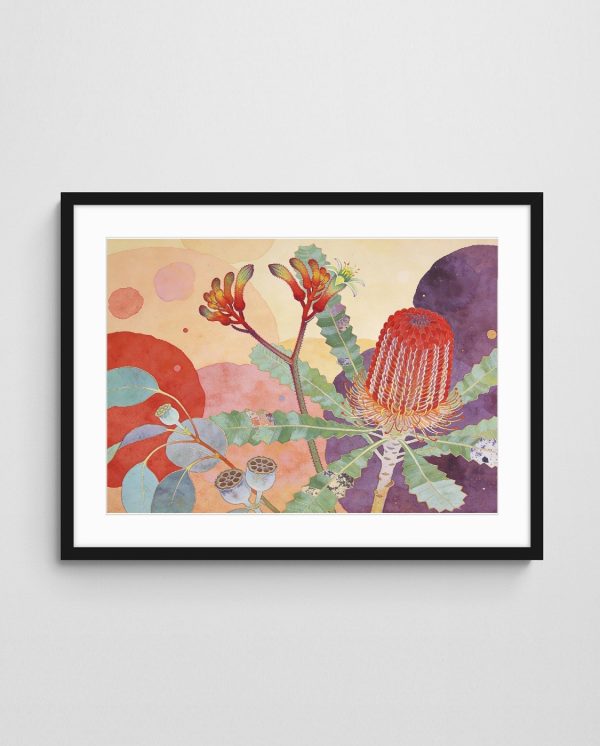
This approach has led to innovations in colour field painting that diverge significantly from American precedents. Where Rothko and Newman worked with large areas of closely valued colours creating subtle atmospheric effects, Australian colour field work often embraces higher contrast and more saturated hues reflecting actual environmental conditions. The “Reef Shadows – Coastal Abstract Painting Print” exemplifies this approach, using bold tonal shifts that mirror the dramatic transition from shallow reef waters to deep ocean trenches—a visual phenomenon unique to coastal areas where continental shelf drops away steeply offshore.


The practical implication for collectors is significant. Work created in response to Australian light conditions translates exceptionally well to contemporary Australian interiors, which are increasingly designed to maximise natural light through large windows and open floor plans. These pieces don’t fight against bright ambient light; they thrive in it, revealing new chromatic relationships as sun angles change throughout the day. This responsiveness to environmental conditions represents a thoroughly modern sensibility—one that embraces change and interaction rather than insisting on static, controlled viewing conditions.
Botanical Forms as Geometric Innovation
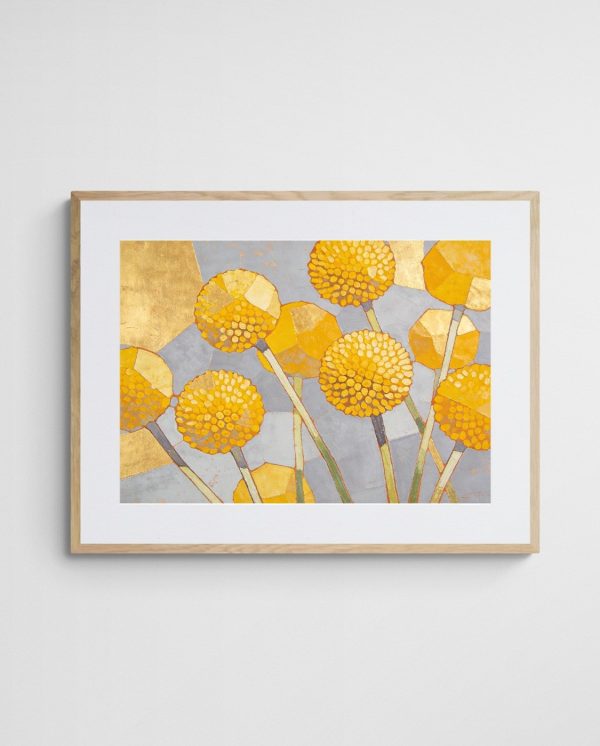
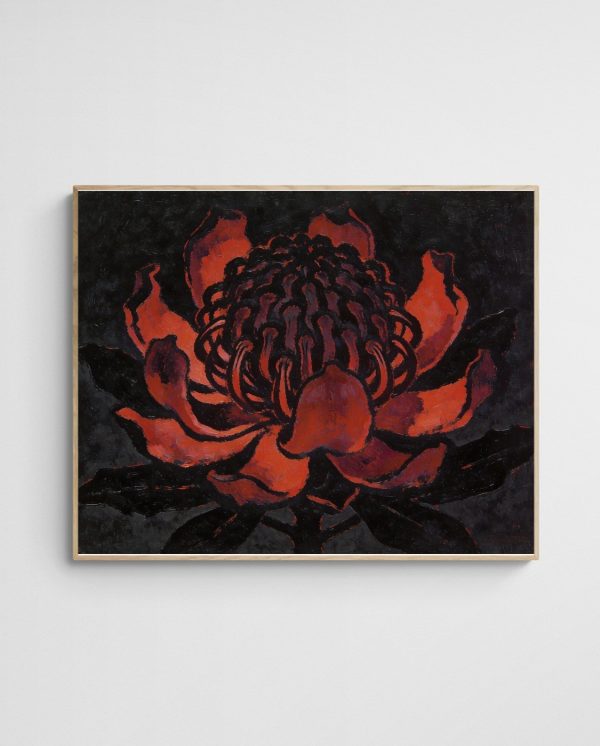
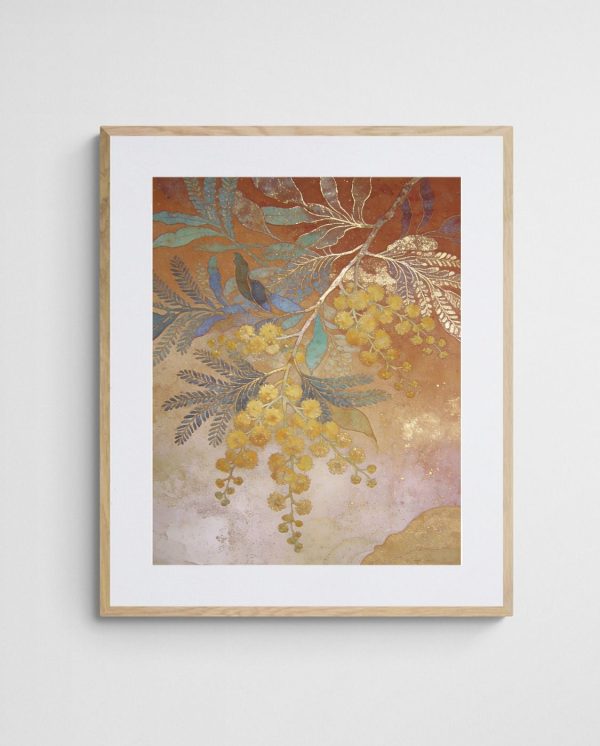
Australian native flora presents some of the most visually striking and geometrically complex plant forms on Earth. Banksia flower spikes, grass tree blooms, wattle clusters, waratah petals—these structures evolved in isolation from northern hemisphere botanicals, resulting in shapes and patterns that feel simultaneously organic and architectural. Contemporary artists have recognised these forms as ready-made geometric abstractions that require minimal manipulation to function as compelling contemporary compositions.
This represents a significant departure from European botanical art traditions, which typically emphasised realistic representation serving scientific documentation or decorative purposes. Australian artists working with native flora as abstraction aren’t creating botanical illustrations—they’re extracting essential formal qualities and amplifying them into pure visual experience. A banksia becomes a study in radial symmetry and textural contrast. Eucalyptus bark transforms into an exploration of layered organic patterns and subtle tonal variation.
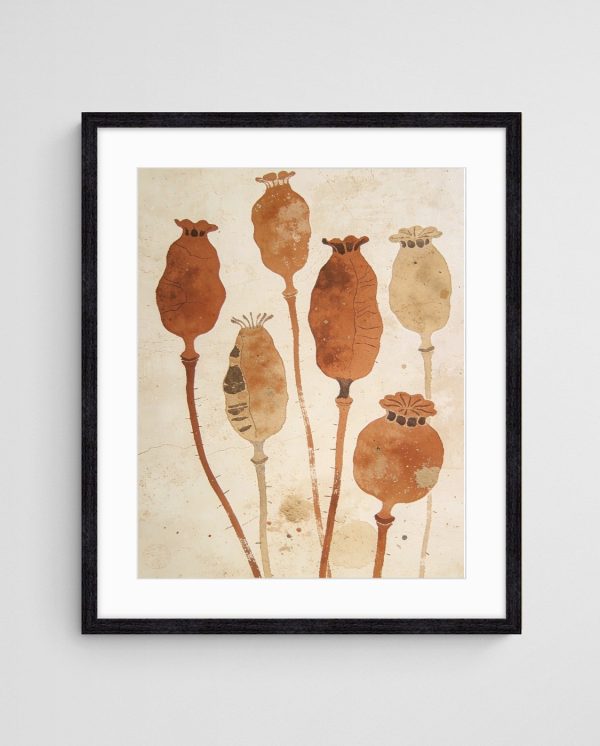
The “Karara Seed Pods – Abstract Botanical Print – Earthy Floral Wall Art” demonstrates this approach beautifully, reducing seed pod forms to their essential geometric components while maintaining just enough botanical reference to ground the abstraction in natural observation. This balance allows the work to function simultaneously as sophisticated abstract composition and celebration of Australian botanical diversity—a duality that European modernism’s insistence on purity would have rejected as conceptually muddled.
Moreover, focusing on native flora rather than introduced European species represents a subtle form of cultural assertion. For generations, Australian gardens and floral art prioritised roses, daffodils, and other imported species that struggled in local conditions while native plants were dismissed as scrubby or unsophisticated. Contemporary artists’ embrace of waratahs, banksias, and eucalyptus in high-end abstract work reverses this colonial hierarchy, positioning Australian botanicals as equally worthy subjects for serious artistic investigation. This shift parallels broader cultural movements toward environmental awareness and appreciation of Australia’s unique ecosystems.


The Commercial Gallery System and Creative Freedom
Australia’s relatively small art market has historically been viewed as a limitation, but it has paradoxically enabled greater creative freedom than artists in larger markets often enjoy. Without the pressure to produce work that fits established market categories or appeals to powerful collectors and institutions, Australian artists can experiment more freely. The financial stakes are lower, which ironically allows for higher creative risks. A failed experiment in a Sydney studio doesn’t carry the same career consequences as a misstep might for an artist embedded in the New York gallery system.
This freedom extends to the relationship between commercial success and critical validation. In major international art centres, commercial galleries often function as gatekeepers determining which artists receive institutional recognition and art historical consideration. Australia’s more fluid boundaries between commercial, public, and artist-run spaces create multiple pathways to visibility and validation. An artist might sell successfully through online platforms while exhibiting in regional galleries and maintaining critical respect—a combination that would seem contradictory in more hierarchical art markets.
The rise of digital platforms and print-on-demand technology has further democratised access to audiences. Artists no longer need gallery representation to reach collectors, and collectors no longer need to visit physical galleries to discover new work. This disintermediation has been particularly significant for abstract artists, whose work often photographs well and translates effectively to digital viewing. The Australian abstract art market has embraced this technological shift enthusiastically, with many artists building substantial followings entirely through social media and online galleries.
However, this commercial accessibility hasn’t led to lowest-common-denominator aesthetics. In practice, Australian collectors have demonstrated sophisticated taste and willingness to engage with challenging work. The absence of rigid modernist orthodoxy means that formally innovative work doesn’t require extensive theoretical justification to find audiences. A piece can be visually beautiful, technically accomplished, and conceptually serious without apology—a combination that academic modernism often viewed with suspicion but that contemporary Australian practice embraces as perfectly coherent.
Digital Tools and Traditional Sensibilities
Contemporary Australian artists navigate between digital and analogue processes with remarkable fluidity, refusing to treat these as opposing categories. While European and American art discourse often frames digital technology as either threat to traditional craft or radical rupture enabling entirely new practices, Australian artists tend toward pragmatic integration. Digital tools serve whatever the work requires—colour testing, compositional planning, final output—without becoming either fetishised or demonised.
This pragmatism reflects broader Australian cultural attitudes toward technology adoption. Without deep investment in defending traditional methods as inherently superior, artists feel free to use whatever tools produce the desired results most effectively. A painter might develop compositions through digital sketching, transfer key elements to canvas through projection, then complete the work with traditional brushwork. This hybrid process would have horrified modernist purists who insisted on medium specificity, but it produces sophisticated results that honour both digital possibility and material craft.
The accessibility of high-quality digital printing has been particularly transformative. Artists can now create limited edition prints that capture subtle tonal variations and colour accuracy impossible with traditional printmaking methods, while maintaining the affordability and accessibility that traditional prints provided. This democratisation of quality has expanded audiences significantly, allowing people to own museum-quality reproductions of original works at prices that don’t require institutional budgets or collector-level wealth.
Furthermore, digital tools enable experimentation without material waste—a consideration increasingly important as environmental consciousness shapes artistic practice. An artist can test dozens of colour combinations digitally before committing paint to canvas, reducing both material consumption and studio waste. This efficiency doesn’t diminish the work’s authenticity; it simply acknowledges that contemporary art practice exists within broader ecological contexts that previous generations of artists could afford to ignore. The integration of sustainable practices into art production represents another way Australian artists are redefining modernism for current conditions.


Why This Matters for Interior Spaces
The redefined modernism emerging from Australian studios has profound implications for how we think about art in residential and commercial interiors. Traditional modernist abstraction, with its emphasis on formal purity and intellectual rigor, can feel cold in domestic spaces—beautiful but unapproachable, demanding contemplation rather than inviting habitation. Australian abstract work, by maintaining connections to landscape, light, and botanical forms, achieves sophistication without sacrificing warmth or accessibility.
This quality makes it particularly effective for transforming living spaces where people actually spend time rather than simply pass through. A colour field painting inspired by coastal waters doesn’t just provide visual interest; it evokes the psychological benefits of proximity to ocean—calmness, expansiveness, connection to natural rhythms. Abstract botanical prints bring biophilic design principles into spaces where actual plants might be impractical, satisfying the human need for nature connection through visual representation rather than literal presence.
The horizontal emphasis common in Australian landscape abstraction also suits contemporary architectural preferences for wide walls and open floor plans better than vertically oriented European compositions. A panoramic abstract landscape naturally complements the proportions of modern living rooms with large windows and minimal interior walls. This formal compatibility isn’t coincidental—both contemporary architecture and contemporary Australian art respond to similar conditions of light, space, and relationship to outdoor environments.
Australian abstract art succeeds in interiors precisely because it refuses the false choice between aesthetic sophistication and emotional accessibility, proving that contemporary art can be both intellectually rigorous and genuinely liveable.
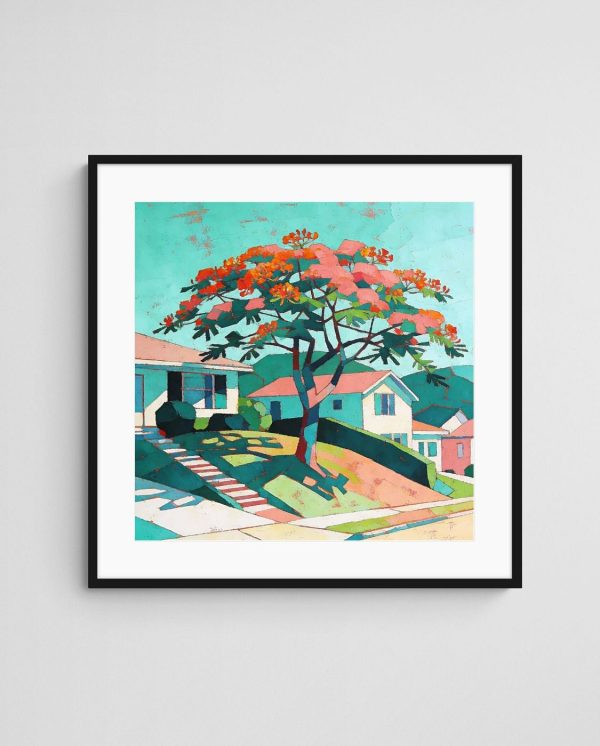
Commercial spaces benefit equally from this approach. Reception areas and office environments require art that projects professionalism without sterility, that creates positive first impressions without demanding extended viewing time. Abstract work rooted in recognisable Australian imagery—coastal scenes, native florals, urban landscapes—communicates sophistication while remaining approachable to diverse audiences. A client waiting in a reception area might not consciously identify a piece as abstracted wattle, but the familiarity of golden yellows and organic forms registers subconsciously, creating comfort rather than alienation.
The colour palettes emerging from Australian practice also align remarkably well with current interior design trends. The earthy neutrals, coastal blues, and botanical greens that dominate contemporary Australian abstract art correspond almost exactly to the colour schemes favoured in modern homes. This isn’t simply artists following design trends—it reflects shared response to Australian environmental conditions and aesthetic preferences that have emerged organically from place-based experience rather than being imposed by international style dictates.


Additionally, the accessibility of high-quality prints means that this redefined modernism isn’t restricted to wealthy collectors or institutional spaces. A young professional furnishing their first apartment can access the same aesthetic sophistication as an established collector, simply at different scales and price points. This democratisation represents a fundamental break from modernism’s historical association with elite cultural capital, suggesting that contemporary abstract art can be both culturally significant and genuinely accessible—another binary that Australian practice has refused to honour.
The relationship between original works and prints also operates differently in the Australian context. Rather than viewing prints as inferior compromises for those who cannot afford originals, many Australian artists embrace printmaking as a distinct practice with its own integrity. Limited edition prints aren’t simply reproductions—they’re deliberate artistic choices about scale, medium, and audience. This attitude removes much of the anxiety around “authenticity” that can make art collecting feel intimidating, instead positioning print acquisition as a legitimate form of engagement with contemporary art practice.
From a practical perspective, prints offer significant advantages for interior applications. They’re more affordable to experiment with when testing colour schemes or compositional arrangements. They’re easier to transport and install than framed originals. They’re less risky in high-traffic areas where damage is more likely. These practical benefits don’t diminish their aesthetic value—they simply acknowledge that art exists within the realities of how people actually live rather than in idealised contemplative spaces disconnected from daily life.
The environmental considerations of print production also matter increasingly to conscious consumers. Digital printing on archival papers produces minimal waste compared to traditional printmaking methods, and the ability to print on demand eliminates the need for large inventory storage. Many Australian print producers have embraced these sustainable practices, recognising that contemporary collectors—particularly younger demographics—consider environmental impact when making purchasing decisions. This alignment of aesthetic values with ethical consumption represents yet another way the Australian approach to modernism differs from historical precedents that ignored or actively rejected such practical considerations.
Looking forward, the trajectory of Australian abstract art suggests continued evolution rather than arrival at a definitive style. The willingness to integrate diverse influences—Indigenous perspectives, digital tools, environmental awareness, commercial accessibility—without insisting on ideological purity positions this practice to respond dynamically to changing conditions. As climate change reshapes Australian landscapes, as technology continues evolving, as cultural conversations develop around reconciliation and environmental stewardship, Australian artists will undoubtedly incorporate these realities into their work without abandoning the core commitment to formal innovation and visual beauty that defines serious abstract practice.


The international art world is gradually recognising what Australian collectors have understood for years—that the most vital contemporary abstract practice isn’t happening in traditional art capitals recycling mid-century aesthetics, but rather in places like Australia where artists feel free to cherry-pick from modernism’s legacy while discarding its limitations. This recognition doesn’t require Australian artists to compromise their distinctive approaches to gain international validation; instead, it reflects growing awareness that modernism’s future lies in multiplication of possibilities rather than adherence to singular orthodoxies.
For anyone seeking to incorporate contemporary abstract art into their living or working environments, Australian practice offers a compelling model. It demonstrates that sophistication doesn’t require coldness, that innovation doesn’t demand incomprehensibility, and that local specificity can generate universal resonance. The work emerging from Australian studios proves that we can have both—aesthetic rigor and emotional warmth, formal experimentation and accessible beauty, contemporary relevance and connection to place. This isn’t a watered-down compromise between opposing values but rather a mature recognition that such oppositions were always false constructs serving institutional interests rather than creative truth.
The question, then, isn’t whether Australian artists are redefining modernism—that much is evident to anyone paying attention. The more interesting question is what this redefinition suggests about contemporary art’s broader trajectory. If modernism’s core principle was the freedom to innovate beyond established conventions, then Australian artists who refuse to be bound by modernism’s own conventions are perhaps its most faithful inheritors. They’ve recognised that the movement’s revolutionary spirit matters more than its specific formal solutions, that breaking modern requires the same courage that creating modern once demanded, and that the most radical artistic gesture might be rejecting radicalism as a requirement altogether.

This evolution reflects maturity rather than rebellion. It’s not angry rejection of European precedents but confident assertion that Australian conditions—geographic, cultural, historical—generate equally valid starting points for contemporary practice. The continent’s ancient landscapes, its complex colonial and Indigenous histories, its unique light and ecology, its distance from traditional art centres—these aren’t deficits to be overcome but resources to be embraced. When Australian artists mine these resources with intelligence and skill, the results contribute something genuinely new to global contemporary art discourse: a demonstration that modernism’s legacy is large enough to accommodate multiple expressions, specific enough to ground meaningful innovation, and flexible enough to evolve beyond its own origins into something richer and more relevant for our current moment.
Frequently Asked Questions
What makes Australian modernism different from European modernism?
Australian modernism differs fundamentally by refusing to separate abstraction from representation, instead creating hybrid works that draw from local landscapes, coastal light, and native flora. Where European modernism insisted on formal purity and rejection of traditional subject matter, Australian artists integrate these elements freely, producing work that is simultaneously abstract and deeply connected to place. This approach emerged from Australia’s unique cultural context—lacking the industrial trauma and urban density that shaped European modernism—and has resulted in a more flexible, place-responsive interpretation of contemporary abstract practice.
How has Indigenous art influenced contemporary Australian abstract practice?
Indigenous Australian art represents the world’s oldest continuous abstract tradition, predating European modernism by tens of thousands of years. Contemporary non-Indigenous artists have learned conceptual approaches from this tradition—particularly the idea that abstract visual languages can simultaneously convey aesthetic, narrative, and spiritual content—without appropriating specific Indigenous imagery. Indigenous artists themselves are also creating powerful contemporary work that maintains connection to traditional knowledge while engaging with modern materials and formats, demonstrating that the most vital practice often emerges from dialogue between ancient and contemporary rather than rejection of the past.
Why does Australian abstract art work so well in contemporary interiors?
Australian abstract art succeeds in interior spaces because it achieves sophistication without coldness, maintaining connections to landscape, light, and natural forms that make it emotionally accessible while remaining formally innovative. The horizontal compositions common in Australian landscape abstraction suit modern open-plan architecture beautifully, while colour palettes drawn from coastal and botanical sources align naturally with contemporary design preferences. Additionally, work created in response to intense Australian light conditions performs exceptionally well in bright, naturally-lit interiors rather than requiring controlled gallery lighting, making it ideal for actual living spaces.
Are art prints as valuable as original paintings for collectors?
In the Australian art context, high-quality limited edition prints are valued as legitimate artistic expressions rather than inferior reproductions. Many artists treat printmaking as a distinct practice with its own integrity, creating work specifically for the print medium rather than simply reproducing paintings. Modern digital printing technology can capture subtle tonal variations and colour accuracy that rival originals while offering practical advantages for interior applications—affordability, ease of installation, lower risk in high-traffic areas. For collectors, prints provide accessible entry points to contemporary art practice without compromising on aesthetic quality or cultural significance.
How do I choose Australian abstract art for my space?
Start by considering your existing colour palette and the natural light conditions in your space, as Australian abstract work often responds dynamically to changing light throughout the day. Look for pieces that incorporate colours already present in your interior or that introduce complementary tones you want to emphasise. Consider the emotional quality you want the space to convey—coastal abstracts typically create calm, expansive feelings, while botanical works bring warmth and organic energy. Scale matters significantly; contemporary Australian practice often embraces larger formats that suit open-plan living areas, though smaller works can create intimate focal points in compact spaces or as part of gallery wall arrangements.
 | Joseph Russell Joseph is an Australian abstract artists and curator of the Inomaly art collection. |