
When HOFA Gallery launched “Beyond the Screen” at its Mayfair location on 5 May 2023, post-digital art moved decisively from laptop screens to lounge room walls. The exhibition featured works valued at $5 million from artists including XCOPY, Ovie Faruq, and Agoria. Meanwhile, Samsung, Hisense, and TCL transformed this shift into accessible home design solutions, with their gallery-scale digital art displays achieving 47% year-over-year growth in 2024.
This convergence of fine art curation and consumer technology signals a fundamental shift in how homeowners collect and display art. The Art Basel and UBS Survey of Global Collecting 2025 revealed that 51% of collectors purchased digital artwork in 2024-2025, with the average share of digital art in collections jumping from 3% in 2024 to 13% in 2025. Post-digital aesthetics now inform everything from the geometric abstracts we hang in our homes to the dynamic displays that replace traditional paintings. This article examines how specific artists, galleries, and technology platforms are reshaping residential interiors through post-digital art in home design, complete with measurable impacts on both the art market and domestic spaces.
From Gallery Walls to Living Rooms: The HOFA Gallery Precedent
HOFA Gallery’s “Beyond the Screen” exhibition established a crucial precedent for how post-digital works translate to physical viewing environments. The gallery, which became the first in the world to accept cryptocurrency payments in 2018, deliberately curated the exhibition to explore how digital and AI-generated works function when removed from their native screen-based context. Artist and co-curator Ovie Faruq, who transitioned from high-yield credit and derivatives trading at Barclays to become the highest-selling lot at Sotheby’s Digital auction for his work “Carnaby Street”, brought a collector’s perspective to the display methodology.
The exhibition featured works from XCOPY, described as one of the “OG” NFT artists, alongside pieces from Orkhan, DeeKay, Gavin Shapiro, Cath Simard, Alpha Centauri Kid, 25m42, Ivona Tau, and French digital artist Agoria, who created “Compend AI-XI”, an immersive display that demonstrated how post-digital aesthetics could command physical space. This approach influenced how homeowners began to consider digital art not merely as screen-savers but as deliberate design choices comparable to traditional paintings. The exhibition’s $5 million valuation underscored that post-digital works now carry institutional weight beyond their digital origins.

HOFA’s strength lay in its emphasis on scale, lighting, and spatial relationships. Unlike traditional digital art displays on computer monitors, the gallery presented works at dimensions that competed with conventional paintings, establishing sight lines and viewing distances that homeowners could replicate in residential settings. This methodology directly informed the development of consumer-grade digital art displays that emerged in 2024 and 2025, which prioritised gallery-scale presentation over traditional television dimensions.
Smart Display Technology: Samsung, Hisense, and TCL Transform Home Art
Samsung’s introduction of The Frame in 2017 created the foundational concept, but it was the 2025 launch of The Frame Pro and the expansion of the Art Store to over 3,000 curated works at $5.99 monthly that made post-digital art practical for everyday homes. The lifestyle TV category’s 47% year-over-year growth in 2024 reflected genuine consumer demand for displays that function as both entertainment devices and art presentation platforms. Samsung’s Art Store subscription model removed the barrier of commissioning or purchasing individual digital works, providing rotating access to a curated collection that spans classical reproductions, contemporary digital art, and NFT-compatible imagery.
Hisense’s CanvasTV launch in July 2024 democratised access to gallery-scale digital art displays through aggressive pricing. The 55-inch model at $999 and 65-inch at $1,299 came in 30-40% below Samsung equivalents whilst maintaining comparable specifications. By March 2025, Hisense had expanded the line to include 75-inch ($2,499.99) and 85-inch ($3,999.99) models, bringing post-digital art presentation to dimensions previously reserved for commercial installations. This pricing strategy made it feasible for homeowners to dedicate wall space specifically to digital art displays rather than treating them as dual-purpose entertainment devices.
TCL’s NXTFRAME introduced AI-adaptive functionality that represented a genuine advancement in how digital art responds to residential environments. The system’s integrated AI automatically adjusts displayed content based on ambient lighting, time of day, and detected room occupancy patterns, learning user preferences over weeks of operation. This sub-two-inch profile device with customisable bezels marked the first time digital art displays could genuinely replicate the unobtrusiveness of framed prints. For homeowners interested in how to display abstract paintings at home, these adaptive systems offered a middle ground between traditional prints and dynamic digital content.
Practical Implementation in Home Design
Interior designers began incorporating these digital displays into residential projects with specific protocols. Rather than treating them as television replacements, design specifications positioned them within gallery wall arrangements, often flanked by traditional prints or used as focal points in entry halls. The typical installation pattern involved mounting displays at traditional art heights (centre point at 145-150cm from floor level) rather than media room elevations, reinforcing their function as art rather than entertainment technology.
E-Paper Innovation and Sustainable Digital Art
InkPoster’s Duna 40.5, created in collaboration with Italian design firm Pininfarina and presented at Milan Design Week from 20-26 April 2025 at the Reflex Showroom, introduced e-paper technology to premium residential interiors. This A1-format display runs for up to a year on a single battery charge, addressing the primary environmental criticism of backlit digital displays: continuous power consumption. The technology produces genuinely glare-free viewing under direct sunlight and artificial lighting, replicating the optical characteristics of physical prints more accurately than LCD or OLED alternatives.
The Duna 40.5’s appeal lies in resolving a fundamental tension in post-digital art presentation: how to maintain the dynamic flexibility of digital content whilst matching the passive, non-emissive viewing experience of traditional prints. E-paper technology achieves this through reflective rather than emissive display methods, eliminating the characteristic glow that identifies backlit screens. For homeowners committed to sustainable art practices, the year-long battery life and minimal power consumption represented a viable alternative to both traditional printing processes and energy-intensive LCD displays.
However, e-paper displays currently face technical limitations. Refresh rates remain too slow for video content, and colour reproduction lacks the saturation range of backlit alternatives. These constraints position e-paper technology specifically for static or slowly-transitioning imagery rather than dynamic, motion-based content. This technical reality influences which post-digital aesthetics translate most effectively to residential settings, favouring geometric abstracts and pattern-based compositions over video-centric works.
NFT Integration in Residential Spaces
Canvia Digital Art Canvas introduced patented ArtSense technology with 16 GB memory and integration with multiple cryptocurrency wallets, enabling homeowners to display NFT images and videos they actually own. This addressed a specific gap in the post-digital art market: collectors who owned valuable NFTs but lacked appropriate display methods beyond computer monitors. Canvia’s catalogue of 10,000+ pieces spans classic painters, contemporary artists, crypto works, and renowned photographers, providing context that positions NFTs alongside rather than separate from traditional art historical content.
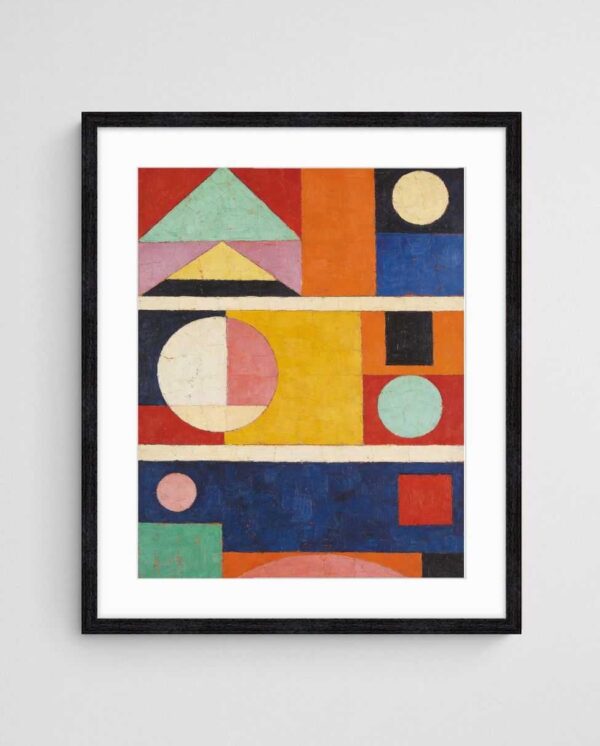
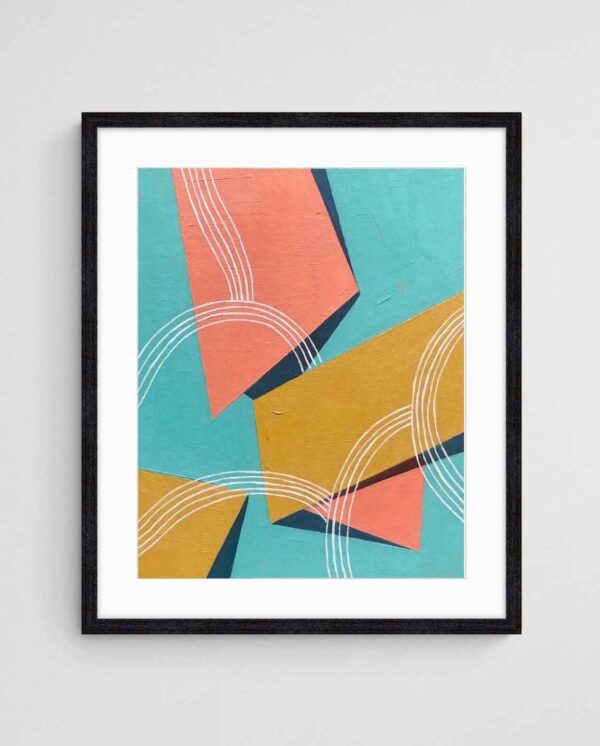
The practical reality of NFT display in homes differs substantially from the speculative frenzy that characterised the 2021-2022 market peak. Homeowners gravitate toward NFTs with aesthetic merit independent of their blockchain provenance, using ownership verification as authentication rather than the primary value proposition. The “Euphoric Dance – Retro Abstract Artwork” exemplifies how post-digital aesthetics influenced by NFT art communities translate to physical spaces through its bold geometric forms and vibrant colour palette, whilst remaining accessible as a traditional print rather than requiring blockchain authentication.

Art Basel’s launch of the Zero 10 section at Miami Beach 2025 provided institutional validation for digital art’s mainstream acceptance in home collecting. The section featured 12 exhibitors including Art Blocks, bitforms gallery, Pace Gallery, and SOLOS, with an interactive installation by Beeple demonstrating how post-digital artists now command gallery floor space previously reserved for traditional media. The Art Basel and UBS Survey’s finding that average digital art shares in collections increased from 3% to 13% between 2024 and 2025 reflected genuine collector behaviour rather than speculative investment, with homeowners integrating digital works into residential displays alongside traditional acquisitions.
Authentication and Provenance in Digital Display
The technical infrastructure supporting NFT display in homes required solving authentication challenges that don’t exist for physical art. Digital displays must verify blockchain ownership, maintain secure wallet connections, and display provenance information without disrupting the viewing experience. This led to interface design patterns that hide technical details during normal viewing whilst making them accessible through on-screen menus, similar to how traditional art labels appear adjacent to rather than upon artworks.
Physical Galleries for Digital Art: The New York Shift
Offline, launched quietly on the Bowery in New York’s Lower East Side in April 2025 with a grand opening in July, represented SuperRare’s transition from purely digital NFT platform to physical exhibition space. Director Mika Bar-On Nesher explicitly stated the goal was experiencing digital art outside of screens, arguing that post-digital works gain different dimensions when viewed in carefully curated physical environments. This position directly contradicted assumptions that digital art’s native habitat was exclusively screen-based.
Heft Gallery, founded by curator and artist Adam Heft Berninger and opened in April 2025 on Broome Street in New York, similarly focused on providing physical context for digital and hybrid works. These galleries didn’t simply mount screens on walls; they developed exhibition methodologies that addressed lighting, viewing angles, spatial relationships, and duration of engagement specific to digital content. The lessons from these institutional spaces filtered into residential design through interior designers who visited the exhibitions and adapted the display strategies for home environments.
The migration of digital art into physical galleries influenced how homeowners approached their own spaces. Rather than treating digital displays as isolated technological objects, the gallery precedent encouraged integration into broader wall compositions, consideration of ambient lighting conditions, and curation of content sequences that evolved over hours or days rather than minutes. This approach aligns with strategies for turning any room into an art gallery, applying professional curation methodologies to residential contexts.
Translating Digital Aesthetics to Print
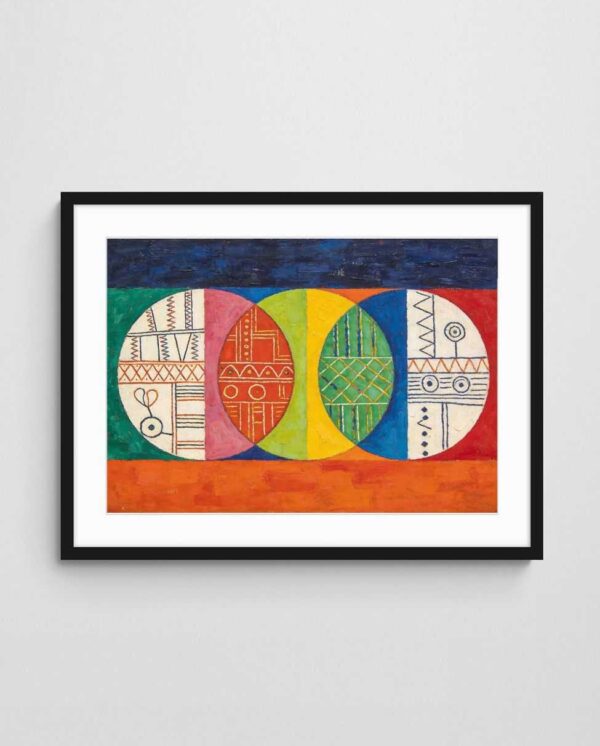
Not all post-digital art requires digital display. Many artists working with digital tools produce final works specifically for traditional print media, bringing post-digital aesthetics into homes through conventional framing and hanging methods. The “Geo-desert Sun Triad – Bold Vintage Geometric Abstract Print” demonstrates how digitally-created compositions translate to physical formats whilst retaining the precision, colour relationships, and geometric complexity characteristic of screen-based creation. This hybrid approach removes technical barriers associated with digital displays whilst maintaining the visual language developed through post-digital practices.
Traditional print production of digitally-created works offers practical advantages. Prints require no power consumption, suffer no screen burn-in, face no software obsolescence, and integrate seamlessly into existing hanging systems. The giclée printing process, detailed in our guide to framing and hanging giclée prints, reproduces digital files with colour accuracy and archival stability that matches or exceeds traditional media. For post-digital artworks characterised by geometric precision and flat colour fields, print reproduction often proves indistinguishable from screen display.


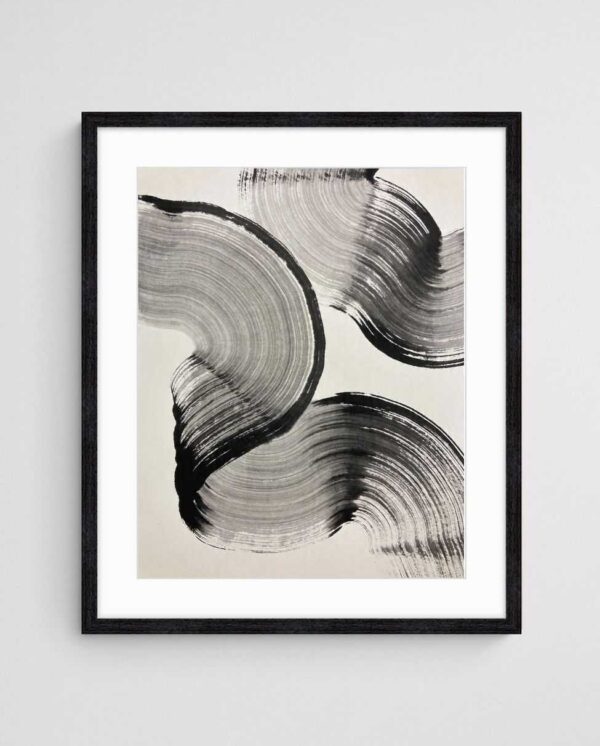
The choice between dynamic digital display and static print reproduction depends on whether the work’s essential character requires motion, transformation, or interactivity. Works conceived as evolving sequences or responsive to viewer input necessitate digital display infrastructure. Compositions designed as resolved statements benefit from print media’s permanence and integration into traditional interior design workflows. The “Ink Ribbons 2 – Minimalist Abstract Art Print in Monochrome” exemplifies post-digital precision translated to traditional print format, its flowing forms created through digital tools but experienced through the same hanging and viewing protocols as conventional abstracts.
Colour Accuracy Across Media
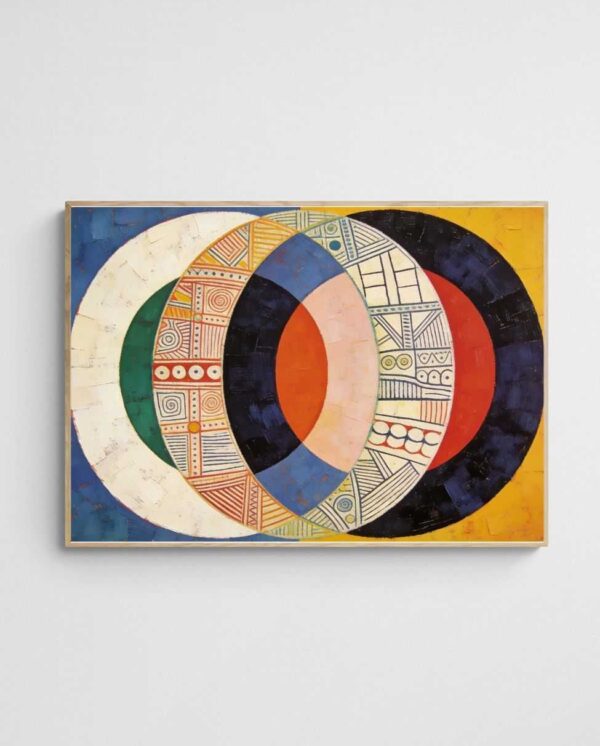
Post-digital artists working across both screen and print media must account for fundamental differences in colour reproduction. Screens use additive RGB colour mixing with backlit emission, whilst prints employ subtractive CMYK with reflected light. This technical reality means that artists creating for both formats develop colour palettes that translate effectively across media rather than exploiting the full gamut of either system. Works like “Circles of Civilisation 4 – Mid Century Geometric Abstract Circle Art Print” use colour relationships that maintain their visual impact whether viewed on calibrated displays or archival prints.
Interior designers working with post-digital aesthetics increasingly specify works in both formats for single spaces, using digital displays for content that benefits from temporal variation whilst hanging traditional prints where permanence serves compositional needs. This hybrid approach, informed by institutional practices at galleries like HOFA and Offline, treats post-digital art as a design language rather than a technical category. The geometric precision and bold colour fields characteristic of post-digital composition work equally well whether delivered through pixels or ink, as demonstrated in our colourful abstract art collection.
Scale Considerations in Print Production
Digital creation enables artists to work at theoretically unlimited resolution, but print production imposes practical constraints based on viewing distance and production costs. Post-digital artists typically create master files at 300-600 DPI for print production, significantly exceeding screen resolution but remaining within commercially feasible production parameters. This resolution enables print sizes up to approximately 150cm width whilst maintaining edge sharpness appropriate for residential viewing distances of 2-3 metres.
The technical workflows connecting digital creation to physical prints have matured substantially since 2020, with colour management systems enabling reliable translation from screen to print. Artists working in post-digital modes now routinely produce both digital display files and print-optimised versions from single master compositions, adjusting colour profiles and resolution parameters for each output medium. This dual-output approach maximises accessibility, allowing collectors to choose display methods suited to their technical preferences and interior design requirements.
The distinction between “digital” and “traditional” art continues to blur within residential contexts. Samsung, Hisense, TCL, and InkPoster have made digital display genuinely viable for home art presentation, whilst advanced printing processes enable post-digital aesthetics in conventional formats. HOFA Gallery, Art Basel, and the New York gallery scene have established post-digital work as collectible and culturally significant rather than technologically novel. For your home, this evolution means choosing the presentation method that serves each artwork best: adaptive screens for evolving compositions, e-paper displays for sustainable static works, or archival prints for permanent installations. Whether on screen or paper, post-digital art has definitively moved beyond the laptop to reshape how we experience visual culture in our homes.
 | Joseph Russell Joseph is an Australian abstract artists and curator of the Inomaly art collection. |