
Piet Mondrian reduced painting to a handful of lines and colours, and in doing so changed how we think about order in art. That radical restraint is the heart of neo-plasticism, and it still shapes how we choose abstract wall art for modern Australian homes.
Neo-plasticism, founded by Mondrian and Theo van Doesburg in the Netherlands around 1917, rests on seven core principles. They are straight lines, right angles, primary colours, neutral tones, asymmetrical balance, flat surfaces and universal harmony. Understanding them helps you spot the movement’s influence in contemporary prints and style it with confidence.
Principles 1-3: The Visual Language
1. Straight Horizontal and Vertical Lines
Neo-plasticists banned curves and diagonals. Only horizontals and verticals remained, because they represent the two fundamental forces of nature: gravity and the horizon. For a deeper look at crisp-edged abstraction, see our guide to hard edge painting.
2. Right Angles Only
Every intersection meets at ninety degrees. This creates a grid that feels stable and rational. In practice, it is why neo-plasticist-inspired prints sit so comfortably in architectural interiors.
3. Primary Colours
Red, yellow and blue were the only hues permitted. Mondrian believed they were the purest colours, free from natural association. Our colour blocking ideas show how that logic translates to walls.
The “Pastangular – Geometric Abstract Art in Pastel Tones” softens this language with gentle hues while keeping the angular structure. Meanwhile, “Warm Geometric Abstract – Lava Flow 1” shows how a restricted warm palette still delivers punch.

Principles 4-5: Composition and Balance
4. Black, White and Grey as Neutrals
Mondrian used white planes and thick black lines to give colour room to breathe. These neutrals act as the quiet voice in the composition. Consequently, the movement pairs naturally with black and white art ideas for minimalist spaces.
5. Asymmetrical Balance
Neo-plasticism avoids mirror symmetry. Instead, a large white rectangle might be offset by a small red square, creating tension that resolves into equilibrium. A common mistake when hanging art is centring everything. What works well is letting one bold element sit off-centre.
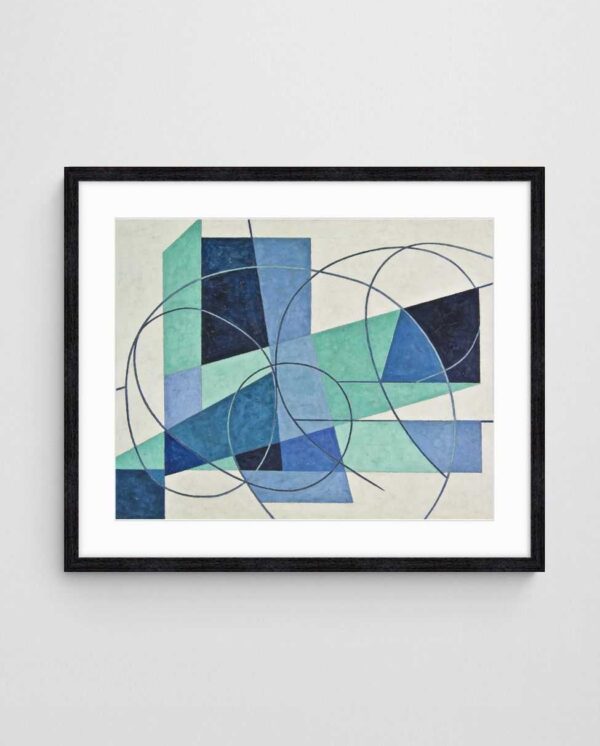
The “Chilled Whispers – Blue Geometric Abstract Art Print” demonstrates this balance with cool tones and linear structure. Likewise, “Crossing Paths 9” uses intersecting lines in a way that echoes Mondrian’s grid.

Principles 6-7: Flatness and Harmony
6. A Flat Picture Plane
There is no illusion of depth, no shading and no perspective. The surface is honest about being a surface. This rejection of illusion links neo-plasticism to the wider shift described in our abstract versus figurative art overview.
7. Universal Harmony
Mondrian wanted art to express universal order rather than personal emotion. The movement belonged to the De Stijl group, documented in De Stijl (Wikipedia). Its influence runs through architecture, furniture and graphic design.
Today, neo-plasticism informs minimalism and geometric abstraction alike. For the full history, read our neo-plasticism guide.
Neo-Plasticism Principles at a Glance
| Principle | Key Feature | Look for in Prints |
|---|---|---|
| Straight lines | Horizontal and vertical only | Grid structures |
| Right angles | Ninety-degree meetings | Rectangles and squares |
| Primary colours | Red, yellow, blue | Limited, bold palettes |
| Neutrals | Black, white, grey | Generous white space |
| Asymmetry | Dynamic equilibrium | Off-centre focal points |
| Flat plane | No depth illusion | Solid colour fields |
| Harmony | Universal order | Calm, ordered composition |
Bringing the Principles Home
You do not need a pure Mondrian replica. Instead, choose prints that borrow two or three principles, such as geometry and restrained colour. The “New Wave – Abstract Art Print for Home or Office” and “Sailboats 045 – Minimalist Coastal Abstract Art Print” both apply clean geometry to relaxed Australian themes.
Start with one wall and test the effect. Our abstract art prints range makes it simple to compare options, and our guide to coordinating art with furniture helps with placement.


To begin, pick one geometric print, hang it slightly off-centre and leave generous white space around it. That single step captures the spirit of neo-plasticism.
 | Joseph Russell Joseph is an Australian abstract artists and curator of the Inomaly art collection. |