
When you stand in front of a painting where colours meet in razor-sharp boundaries, where forms refuse to bleed into one another, and where geometric precision dominates every square centimetre—what you’re experiencing is hard edge painting at its most uncompromising. This isn’t abstract art softened by gestural brushwork or atmospheric transitions. It’s abstraction stripped to its boldest essence: flat colour fields separated by crisp, definitive lines that demand you look, not interpret. And frankly, that’s exactly why it matters in contemporary spaces.
Hard edge painting emerged as a deliberate rejection of the emotional theatrics that dominated mid-century abstraction. Where Abstract Expressionism celebrated spontaneity and visible brushstrokes, hard edge painters eliminated every trace of the artist’s hand. The result? Pure optical experience. Geometric shapes in saturated colours, edges so clean they could cut paper, and compositions that prioritise visual impact over narrative content. This movement didn’t whisper—it announced itself with unapologetic clarity.
The Defining Characteristics That Set Hard Edge Apart
Hard edge painting operates according to strict formal principles that distinguish it from other abstract styles. The primary characteristic is the absolute precision of edges where colour fields meet. There’s no gradation, no soft transition, no hint of brushwork—just one colour ending and another beginning with surgical exactness. This technical approach requires meticulous planning and execution, often involving masking tape, rulers, and multiple layers to achieve that flawless boundary.
The colour itself plays a non-negotiable role. Hard edge painters typically work with flat, unmodulated colour areas—each hue maintains consistent saturation across its entire field. This creates a visual experience fundamentally different from traditional painting where colours might shift subtly across a form. The flatness isn’t a limitation; it’s a deliberate choice that forces viewers to engage with pure colour relationships rather than illusionistic depth.
Geometric forms dominate the vocabulary of hard edge painting. Circles, rectangles, triangles, and their variations create compositions that feel both calculated and dynamic. These aren’t the organic, biomorphic shapes of earlier abstraction—they’re forms that echo industrial design, architecture, and technological precision. The “Warm Geometric Abstract – Lava Flow 2” exemplifies this approach with its bold geometric divisions and clean colour separations, demonstrating how hard edge principles translate into contemporary wall art prints that command attention in modern interiors.


Scale and proportion become critical compositional tools. Hard edge painters manipulate the size relationships between colour fields to create tension, balance, or deliberate asymmetry. A large field of intense red might abut a narrow strip of blue, creating optical vibration at their shared edge. These calculated relationships aren’t accidents—they’re strategic decisions about how the eye moves across the picture plane and where visual weight accumulates.
Historical Context: Why Hard Edge Emerged When It Did
The term “hard edge painting” was coined by California art critic Jules Langsner in 1959, but the aesthetic emerged from broader post-war cultural shifts. After the emotional intensity of Abstract Expressionism dominated the 1940s and 1950s, a younger generation of artists sought cooler, more intellectual approaches. They wanted abstraction without the psychological drama, colour without expressionist baggage. This represented a fundamental philosophical shift about what abstract art could be and do.
California became the movement’s epicentre, particularly Los Angeles. Artists like John McLaughlin, Karl Benjamin, and Frederick Hammersley developed hard edge aesthetics independently of East Coast art world trends. The West Coast environment—with its clear light, aerospace industry, and emerging car culture—influenced the movement’s clean, precise aesthetic. There’s an unmistakable connection between hard edge painting’s formal clarity and the streamlined design language of mid-century modernism.
Internationally, similar tendencies emerged under different names. In Britain, artists associated with Constructivism and geometric abstraction pursued comparable formal strategies. The movement shared DNA with Minimalism, though hard edge painters maintained a commitment to colour that Minimalists often rejected. Both movements, however, embraced industrial materials, precise execution, and an anti-romantic stance toward artistic production.
The relationship between hard edge painting and colour field abstraction deserves consideration. While both movements emphasised large areas of flat colour, hard edge painters maintained geometric structure and crisp boundaries. Colour field painters like Mark Rothko or Helen Frankenthaler allowed edges to soften, colours to bleed, creating atmospheric effects. Hard edge rejected that atmospheric quality entirely—what you see is exactly what exists on the canvas surface, no illusion of depth or space beyond the literal paint film.
Technical Precision as Philosophical Statement
The technical demands of hard edge painting weren’t merely about craftsmanship—they represented a philosophical position about art’s purpose. By eliminating visible brushwork and gestural marks, hard edge painters removed traces of individual psychology. The work became about objective visual phenomena rather than subjective emotional states. This aligned with broader mid-century interests in phenomenology and perception studies.
Moreover, the precision mirrored technological optimism of the post-war era. These paintings looked machine-made, even when executed entirely by hand. That aesthetic choice reflected cultural fascination with industrial production, scientific progress, and rational planning. Hard edge painting was modernism’s visual language made manifest—clean, efficient, uncompromising.
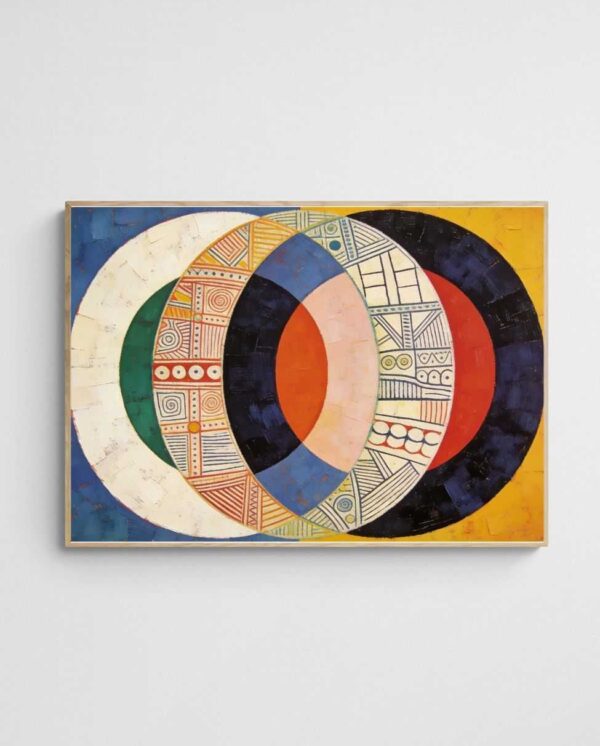

The Visual Impact That Interior Spaces Demand
Hard edge painting brings immediate, unequivocal visual presence to any space. There’s no ambiguity, no need for contemplative gazing to “get it.” The impact is instantaneous and undeniable. This makes hard edge aesthetics particularly effective in contemporary interiors where clean lines and bold statements dominate. The same formal clarity that defined the movement in the 1960s translates seamlessly into current design sensibilities.
Consider how hard edge compositions interact with architectural elements. The geometric precision echoes structural features—doorways, windows, built-in shelving. A hard edge print doesn’t fight against a room’s architecture; it amplifies it. The “Sailboats 042 – Bold Geometric Abstract Art Print” demonstrates this synergy, where geometric forms create visual dialogue with a space’s existing lines and angles while introducing dynamic colour relationships that energise neutral environments.
The colour intensity characteristic of hard edge work provides focal points that transform rooms with statement wall art. Unlike prints with gradated or muted tones that might recede into a space, hard edge compositions assert themselves. They’re confident, sometimes aggressive in their visual demands. This isn’t background decoration—it’s art that shapes how you experience an entire room.
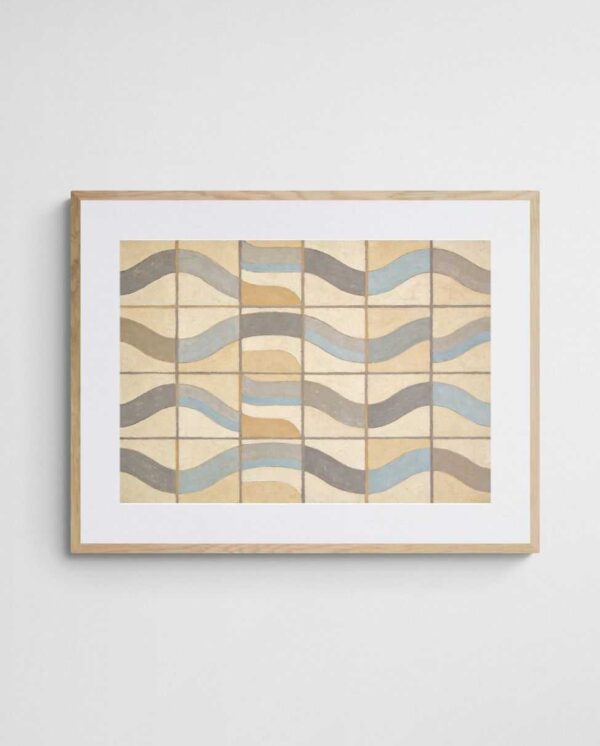
Scale considerations become crucial when incorporating hard edge aesthetics into living spaces. These works often benefit from generous proportions where their geometric forms can achieve proper impact. A small hard edge print might feel constrained, its bold forms unable to breathe. Larger formats allow the colour fields and geometric relationships to establish presence, creating the optical effects the style depends upon for maximum visual engagement.
Colour Psychology in Hard Edge Compositions
The flat, unmodulated colour areas in hard edge painting create different psychological effects than traditional colour application. Because there’s no tonal variation within a colour field, the hue presents itself at full strength. This intensity can energise a space dramatically. The strategic use of carefully selected colour combinations becomes even more critical when working with this aesthetic.
Contrasting colour relationships in hard edge work generate optical phenomena that soften or neutral palettes cannot achieve. Complementary colours placed in hard-edged adjacency create vibration effects where edges appear to shimmer. Analogous colours in geometric arrangements produce harmonious yet dynamic compositions. These aren’t accidental effects—they’re calculated visual experiences that hard edge painters engineered with precision.
Why Hard Edge Painting Remains Uncompromisingly Relevant
In an era saturated with digital imagery and screen-based experiences, hard edge painting’s material directness offers refreshing clarity. There’s no digital mediation, no filter, no post-processing—just pigment on surface with absolute physical presence. This tangibility matters increasingly as our visual culture becomes more virtualised. A hard edge print on your wall exists in the same physical space you inhabit, responding to changing light conditions, asserting material reality.
The aesthetic also aligns perfectly with current interior design trends emphasising minimalism, clean lines, and bold accent pieces. Contemporary spaces often feature neutral palettes punctuated by statement elements—exactly where hard edge compositions excel. The style’s inherent clarity doesn’t compete with architectural features or furniture; it complements them while providing necessary visual interest and colour injection.
Furthermore, hard edge painting’s rejection of narrative content makes it universally accessible. You don’t need art historical knowledge or cultural context to experience its impact. The visual effect is immediate and democratic—geometric forms and colour relationships communicate directly without requiring interpretation. This accessibility doesn’t diminish sophistication; it demonstrates confidence in pure visual experience as sufficient artistic content.
The movement’s influence extends beyond traditional painting into contemporary abstract art prints and digital design. Graphic designers, illustrators, and digital artists regularly employ hard edge principles—flat colours, geometric forms, crisp boundaries. The aesthetic has become part of visual culture’s common language, recognisable across contexts from gallery walls to corporate branding to social media graphics.
Collecting and Living With Hard Edge Aesthetics
When selecting hard edge works for your space, consider how the geometric forms will interact with your room’s proportions. Vertical compositions can emphasise ceiling height; horizontal arrangements expand perceived width. The geometric structure of hard edge painting makes these spatial relationships particularly pronounced. Think architecturally about how the work’s internal geometry echoes or contrasts with the space itself.
Lighting becomes especially important with hard edge compositions. Because colour fields are flat and unmodulated, changing light conditions dramatically affect how hues appear and how edges register visually. Natural daylight reveals colour saturation differently than artificial lighting. Consider how your selected work will perform under various lighting scenarios throughout the day. The consistent flatness of hard edge painting means lighting changes create the only variation in how the work appears.
Hard edge aesthetics also offer flexibility in building art wall arrangements. The geometric clarity allows multiple works to coexist without visual chaos. Where mixing various painterly abstracts might create confusion, hard edge pieces can be grouped effectively because their formal language shares common vocabulary. This makes the style particularly suitable for collectors developing cohesive wall displays across multiple works.
Ultimately, hard edge painting demands that we engage with visual experience on its own terms—not as metaphor, not as emotional projection, but as optical fact. The sharp boundaries, geometric forms, and saturated colour fields create immediate, undeniable presence. In an age of visual noise and endless digital stimulation, that clarity cuts through. Hard edge painting doesn’t whisper or suggest—it states, boldly and without apology. That’s not a limitation of the form; it’s precisely its power and enduring relevance in contemporary visual culture.
 | Joseph Russell Joseph is an Australian abstract artists and curator of the Inomaly art collection. |