
The pendulum has swung away from stark minimalism, and interiors are embracing layers, patterns, and vivid personality like never before. Maximalist design celebrates abundance rather than restraint, transforming modern spaces into curated expressions of individuality through bold colour palettes, eclectic artworks, and rich textures. For homeowners seeking to inject character and warmth into contemporary living environments, maximalist art offers an exhilarating pathway to create rooms that feel lived-in, collected, and utterly unique.
At its core, maximalist art for modern homes rejects the “less is more” philosophy in favour of intentional visual abundance. This approach layers multiple artworks, mixes diverse styles and eras, and champions saturated colours alongside intricate patterns. The result isn’t chaos—it’s carefully orchestrated richness that tells a story through every framed piece, sculpture, and decorative element. Maximalism works particularly well in contemporary Australian homes where natural light and open-plan layouts provide the perfect canvas for dramatic art installations that command attention and spark conversation.
Defining Maximalist Aesthetics in Contemporary Interior Design
Maximalism represents a deliberate departure from the clinical precision of minimalist interiors, yet it demands equal thoughtfulness in execution. This design philosophy emerged as a counter-movement to the all-white, sparse aesthetics that dominated the 2010s, offering instead a celebration of personal collections, vibrant hues, and layered visual narratives. In practice, maximalist spaces incorporate multiple artistic movements, time periods, and cultural influences within a single room, creating environments that feel cosmopolitan and deeply personal.
The distinction between maximalism and mere clutter lies in intentionality. Every piece serves a purpose, whether that’s adding complementary colour, introducing textural contrast, or contributing to an overarching theme. Modern maximalism often features bold geometric abstracts alongside vintage botanical prints, or pairs contemporary portraiture with traditional textiles. This eclecticism requires confidence in your aesthetic choices and a willingness to experiment beyond conventional matching rules.
Australian homes particularly benefit from maximalist approaches that incorporate our unique relationship with colour and landscape. The intense blues of coastal regions, the ochres and reds of the outback, and the verdant greens of tropical areas all find expression in maximalist interiors that reference our environment without literal representation. The abundant natural light in Australian dwellings prevents heavily decorated spaces from feeling oppressive, instead allowing layered artworks to reveal new details throughout the day as shadows and illumination shift.
Historical Context and Modern Evolution
Whilst maximalism feels distinctly contemporary, it draws heavily from historical precedents including Victorian parlours, Baroque opulence, and the pattern-rich interiors of the Arts and Crafts movement. Today’s iteration differs through its democratic approach to sourcing—mixing high and low, vintage and contemporary, commissioned pieces with accessible prints—creating collections that reflect genuine personal narratives rather than wealth display. This evolution makes maximalist design more achievable and authentic than ever before.


Colour Theory and Pattern Mixing in Maximalist Art
Successful maximalist colour strategies often begin with an anchor palette—three to five core hues that appear repeatedly across different artworks, textiles, and decorative objects throughout a space. This repetition creates visual threads that guide the eye and prevent chromatic overwhelm. For instance, you might select burnt orange, deep teal, warm terracotta, cream, and charcoal as your foundation, then introduce variations and accents within this framework.
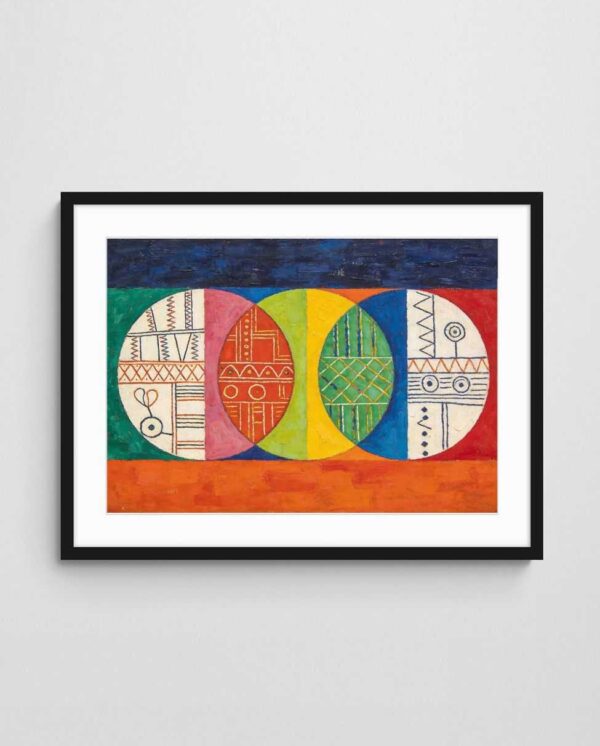
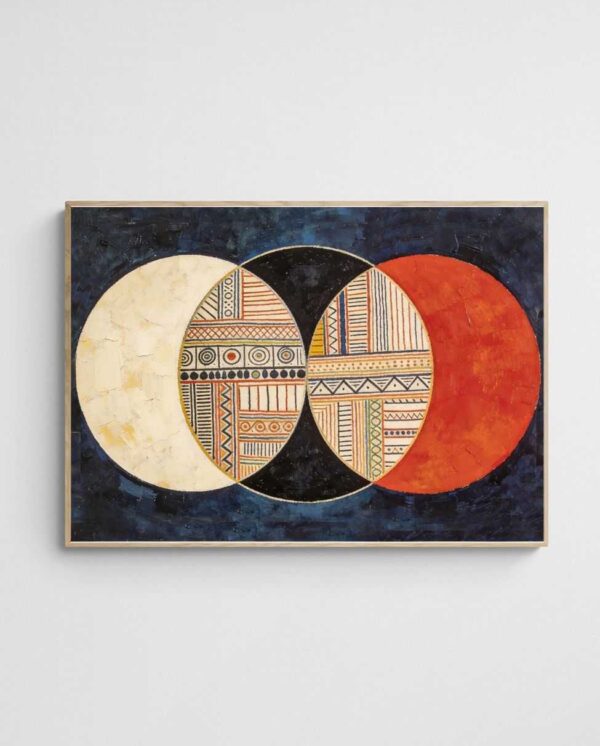
Layering patterns requires similar discipline. A common approach involves establishing a hierarchy: one dominant pattern (perhaps a large-scale abstract piece), one or two medium-scale supporting patterns (geometric prints or florals), and smaller accent patterns (detailed line work or textures). These operate at different visual weights, preventing competition while maintaining abundant interest. The “Warm Geometric Abstract – Lava Flow 2” exemplifies this principle, offering bold shapes that anchor a wall whilst remaining compatible with more intricate surrounding pieces.

Contrast plays a crucial role in preventing maximalist spaces from becoming monotonous despite their visual density. Pair saturated colours with neutrals, busy patterns with solid blocks, and intricate details with breathing room. This rhythmic variation prevents eye fatigue and creates natural focal points within your curated abundance. Understanding colour blocking strategies helps structure these complex schemes.
Working With Complementary and Analogous Schemes
Complementary colour pairings—opposites on the colour wheel like blue and orange or purple and yellow—generate dynamic tension that energises maximalist arrangements. However, using these combinations at full saturation across large areas can become jarring. Instead, vary the tones: pair a vivid accent with its complement rendered in a muted or pastel version. Analogous schemes using neighbouring colours (blues, greens, and teals, for example) create more harmonious abundance whilst still offering plenty of variety for layered compositions.
| Design Element | Maximalist Approach | Key Consideration |
|---|---|---|
| Colour Palette | 5-8 repeating hues across space | Vary saturation and tone within each colour family |
| Pattern Scale | Mix large, medium, and small | Establish one dominant pattern per wall or zone |
| Frame Styles | Eclectic mix of materials and finishes | Unified by consistent spacing or layout grid |
| Subject Matter | Multiple genres and styles | Connect through colour, mood, or conceptual theme |
| Wall Coverage | 60-85% of available wall space | Leave strategic gaps for visual rest |
Layering Techniques: Building Visual Depth Through Art
Physical layering transforms flat walls into three-dimensional galleries. This technique involves overlapping frames, leaning pieces against walls in front of hung works, and using shelving systems that allow artworks to be stacked and rearranged. Gallery ledges prove particularly effective for maximalist displays, enabling you to position smaller works in front of larger anchor pieces and adjust compositions without creating new wall holes.
Depth also emerges through varying frame profiles and matting choices. Combining thin metal frames with chunky wooden ones, or pieces with deep mats alongside flush-mounted prints, creates shadows and dimensional interest that prevents walls from reading as flat despite their visual density. This physical variation complements the visual complexity of the artworks themselves, reinforcing the curated, collected-over-time aesthetic that defines successful maximalism.
Salon-style hanging—where artworks cover a wall from floor to ceiling in an asymmetrical arrangement—epitomises maximalist display philosophy. Rather than adhering to rigid alignment, these installations create organic compositions where pieces of varying sizes nestle together, unified by consistent spacing between frames (typically 5-8 centimetres). The “Call of the Wild 7 – Colourful Abstract Floral Art Print” works beautifully in such arrangements, its vibrant botanical abstraction adding organic complexity alongside geometric and portrait pieces.


Creating Zones Within Open-Plan Spaces
In contemporary open-plan homes, maximalist art serves a functional purpose beyond aesthetics: it defines distinct zones within flowing spaces. A densely curated gallery wall behind a dining area differentiates it from an adjacent living zone, whilst colour coordination maintains overall cohesion. This strategic placement guides movement and creates psychological boundaries without physical barriers, particularly valuable in Australian homes where indoor-outdoor flow and open layouts dominate modern architecture. Exploring effective display strategies for abstract paintings provides additional insight into spatial planning.
Room-Specific Maximalist Strategies
Living rooms offer the greatest scope for maximalist expression, with larger wall expanses and multiple viewing angles. Consider creating a statement wall that serves as the room’s centrepiece, then echo its colours and themes in smaller groupings on adjacent walls. Mix large anchor pieces with clusters of smaller works, ensuring your living room wall art reflects the room’s function as both a personal retreat and entertainment space.
Bedrooms require more careful calibration—whilst maximalist, they shouldn’t feel chaotic before sleep. Focus abundance on one or two walls rather than surrounding the bed completely. Warmer colour palettes tend to work better than cool tones in sleeping spaces, and consider incorporating vintage or nostalgic pieces that evoke comfort. The wall opposite the bed offers prime real estate for an elaborate gallery arrangement that becomes part of your waking routine without overwhelming your rest.
Hallways and transitional spaces benefit tremendously from maximalist treatment, transforming neglected areas into destination galleries. These narrow spaces actually suit dense hanging arrangements, as viewers pass through rather than spending extended time surrounded by visual intensity. Use hallways to showcase smaller works that might get lost in larger rooms, creating intimate viewing experiences that reward close inspection.
Kitchen and Dining Considerations
Kitchens present unique challenges due to moisture, heat, and grease exposure. Position maximalist art displays away from cooking surfaces, focusing on dining areas and breakfast nooks where artworks remain protected whilst enhancing mealtime ambience. Food-related themes—abstract florals, vintage botanical prints, still life interpretations—create thematic coherence, though unexpected contrasts work equally well. For practical guidance, review strategies for selecting kitchen prints that transform spaces whilst withstanding environmental demands.
The Balancing Act: Cohesion Within Abundance
The greatest challenge in maximalist design lies in achieving cohesion without uniformity. Several strategies help maintain this delicate balance. First, establish visual anchors—larger pieces or particularly striking artworks that ground compositions and provide reference points for the eye. These anchors often feature strong geometric elements or bold colour blocks that cut through surrounding complexity.
Repetition creates rhythm within maximalist arrangements without monotony. This doesn’t mean duplicating identical pieces, but rather repeating visual elements: similar colour temperatures, recurring shapes, or thematic connections. For instance, you might incorporate circular motifs across different styles—a geometric circle print, a portrait with rounded framing, abstract organic curves—that create subtle unity across eclectic selections.
The “Vintage Geometric Abstract – Zigzag Collage 2” demonstrates how repeating geometric vocabulary across different artworks builds cohesion whilst maintaining visual interest through colour and compositional variations. This principle extends beyond individual pieces to overall arrangements, where triangular groupings or grid-based layouts provide underlying structure beneath apparent spontaneity.
When to Edit and Refine
Even maximalists must edit. A useful test involves photographing your arrangements and reviewing them away from the space—distance reveals whether abundance has tipped into disorder. Look for orphan colours that appear only once (add more instances or remove them), areas where visual weight becomes unbalanced, or spots where the eye finds no resting place. Maximalism succeeds when it feels intentional rather than accidental, curated rather than accumulated.
Sourcing and Curating Your Maximalist Collection
Building a maximalist art collection requires both patience and opportunism. Unlike minimalist spaces where every piece must meet exacting criteria, maximalism welcomes diversity—but that doesn’t mean accepting anything. Establish your core palette and thematic interests early, then collect pieces that speak to these foundations whilst introducing variation. This approach prevents collections from becoming incoherent whilst maintaining the eclectic spirit that defines the style.
Mix investment pieces with accessible prints to create depth and authenticity in your collection. High-quality art prints from established collections provide affordable variety, allowing you to experiment with different styles and colours before committing to larger expenditures. This democratic approach to collecting actually strengthens maximalist authenticity—these spaces should reflect genuine passion and discovery rather than coordinated catalogue purchases.
Vintage markets, online platforms, and local artists offer rich hunting grounds for distinctive pieces that add character to maximalist schemes. Look for works with unusual colour combinations, interesting textures, or unexpected subject matter that wouldn’t suit minimalist spaces but thrive within abundant contexts. The goal is building a collection that tells your story through accumulated choices rather than instant decoration.
Seasonal Rotation and Evolution
One advantage of maximalist collecting is the ability to rotate artworks seasonally without leaving walls bare. Swap lighter, brighter pieces for moodier selections as seasons change, or adjust arrangements to reflect evolving tastes. This dynamic approach keeps spaces fresh whilst accommodating ongoing collecting habits—new acquisitions don’t require eliminating existing favourites, just thoughtful integration or rotation into storage for future display.
Common Mistakes and How to Avoid Them
The most frequent maximalist misstep involves neglecting scale relationships. Filling walls exclusively with small works creates visual clutter rather than intentional abundance. Instead, anchor arrangements with larger pieces (at least 60-90 centimetres in one dimension) and build around them with medium and small works. This hierarchy guides the eye and prevents compositions from dissolving into homogeneous busyness.
Another common error is inconsistent spacing between artworks. Whilst maximalism embraces asymmetry, maintaining relatively uniform gaps between frames—even when frame sizes vary—creates subtle order within complexity. Measure and mark positions before hanging, ensuring spacing remains consistent even as arrangements become dense. This discipline separates curated maximalism from haphazard decoration.
Ignoring negative space entirely represents a third pitfall. Even the most abundant maximalist walls benefit from strategic breathing room—blank wall sections that allow the eye to rest and prevent sensory overwhelm. These gaps often work best at corners or edges where they frame rather than interrupt compositions. Understanding broader principles of coordinating abstract art with furniture helps integrate these breathing spaces naturally.
Additionally, failing to consider viewing distance can undermine maximalist schemes. Hallways suit smaller, detailed works that reward close inspection during passage. Living rooms require larger anchor pieces visible from sofas several metres away. Matching artwork scale to typical viewing distances ensures your careful curation receives proper appreciation.


Lighting Considerations for Layered Displays
Maximalist arrangements demand thoughtful lighting to prevent shadows from obscuring artworks or creating visual confusion. Picture lights, track lighting, or strategically placed floor lamps help illuminate layered displays evenly. In Australian homes with abundant natural light, consider how changing sun angles throughout the day affect your arrangements—what looks perfect in morning light might become washed out by afternoon glare. Window treatments that diffuse rather than block light often work best for maintaining consistent viewing conditions.
Building a maximalist home begins with choosing one wall and committing to a core colour palette of five to eight hues. Start by hanging your largest anchor piece, then surround it with medium and smaller works in consistent 5-8 centimetre gaps. Review your arrangement in photos to catch any orphan colours or unbalanced visual weight before adding more pieces. This deliberate, staged approach produces collected-looking spaces far faster than attempting an entire room at once, and gives you the confidence to push beyond safe design choices.
 | Joseph Russell Joseph is an Australian abstract artists and curator of the Inomaly art collection. |