
In today’s competitive business landscape, the best first impressions aren’t just about handshakes and smiles—they’re increasingly shaped by the physical environment visitors encounter the moment they enter your premises. As Australia’s commercial interior design sector experiences unprecedented growth, valued at $8.2 billion in 2024 according to IBISWorld, businesses are investing heavily in reception aesthetics. Recent developments indicate that art selection has moved from an afterthought to a strategic priority, with Melbourne-based design firm Siren Design Group reporting a 340% increase in corporate art consultation requests between January 2023 and December 2024.
The shift towards prioritising reception area art stems from compelling research. A landmark study published in the Journal of Environmental Psychology in March 2024 by researchers at the University of Sydney found that visitors form lasting impressions of business professionalism within 7.3 seconds of entering a reception space, with wall art identified as the second most influential factor after overall cleanliness. Meanwhile, Brisbane-based workplace consultancy Future Space released data in August 2024 showing that companies with curated reception art experienced 23% higher client satisfaction scores and 18% improved employee pride metrics. These aren’t merely aesthetic considerations—they’re measurable business outcomes driving boardroom decisions across Australian commercial sectors.
The Psychological Impact of Reception Art on Business Perception
Dr Sarah Tennant, senior lecturer in organisational psychology at Monash University, has been conducting groundbreaking research into the neuroscience of first impressions in corporate environments. Her team’s findings, presented at the Australian Psychological Society Congress in September 2024, revealed that abstract art in reception areas activates specific neural pathways associated with creativity perception and trustworthiness assessment. Using eye-tracking technology and fMRI scans, Tennant’s research demonstrated that visitors spent an average of 4.2 seconds viewing reception wall art during their initial environmental scan, making it one of the longest-fixated elements in the space.
Furthermore, the research identified distinct response patterns based on art style and colour palette. Geometric abstracts generated the highest associations with organisational competence and precision, while organic abstract forms correlated with perceptions of innovation and adaptability. Interestingly, colour psychology played an even more significant role than previously understood. Blue-dominant artworks increased perceived trustworthiness by 31%, while multi-coloured pieces enhanced creativity associations by 27%. These findings have profound implications for businesses seeking to communicate specific brand attributes through their physical environments, as explored in research on office art and productivity.
The financial services sector has been particularly responsive to these insights. In November 2024, Sydney-based accounting firm PricewaterhouseCoopers Australia announced a comprehensive reception redesign across their 23 national offices, specifically incorporating geometric abstract prints to reinforce their brand positioning around precision and forward-thinking. Partner Rebecca Mills stated that the decision followed extensive client feedback analysis revealing that reception environments significantly influenced client confidence in the firm’s capabilities, particularly among younger, design-conscious decision-makers.


Measuring Emotional Response Through Biometric Analysis
Melbourne research consultancy Emotion Analytics conducted a fascinating study in February 2024, installing biometric sensors in the reception areas of 15 Australian businesses across healthcare, technology, and professional services sectors. Over three months, they measured heart rate variability, skin conductance, and facial micro-expressions of 2,847 visitors. The data revealed that reception spaces featuring abstract art reduced visitor anxiety markers by 19% compared to spaces with no artwork or purely decorative photography. Moreover, the calming effect was measurable within 90 seconds of exposure, suggesting rapid psychological impact.
The study’s lead researcher, Dr James Pemberton, noted particular interest from healthcare providers following the findings. The Royal Children’s Hospital in Melbourne subsequently commissioned a $180,000 reception art program in July 2024, specifically selecting calming coastal abstracts and soft geometric pieces after consulting Emotion Analytics’ data. Early feedback from parents and visitors has been overwhelmingly positive, with comment card analysis showing a 42% increase in positive remarks about the reception environment compared to the previous six-month period.
Recent Industry Developments Reshaping Reception Design
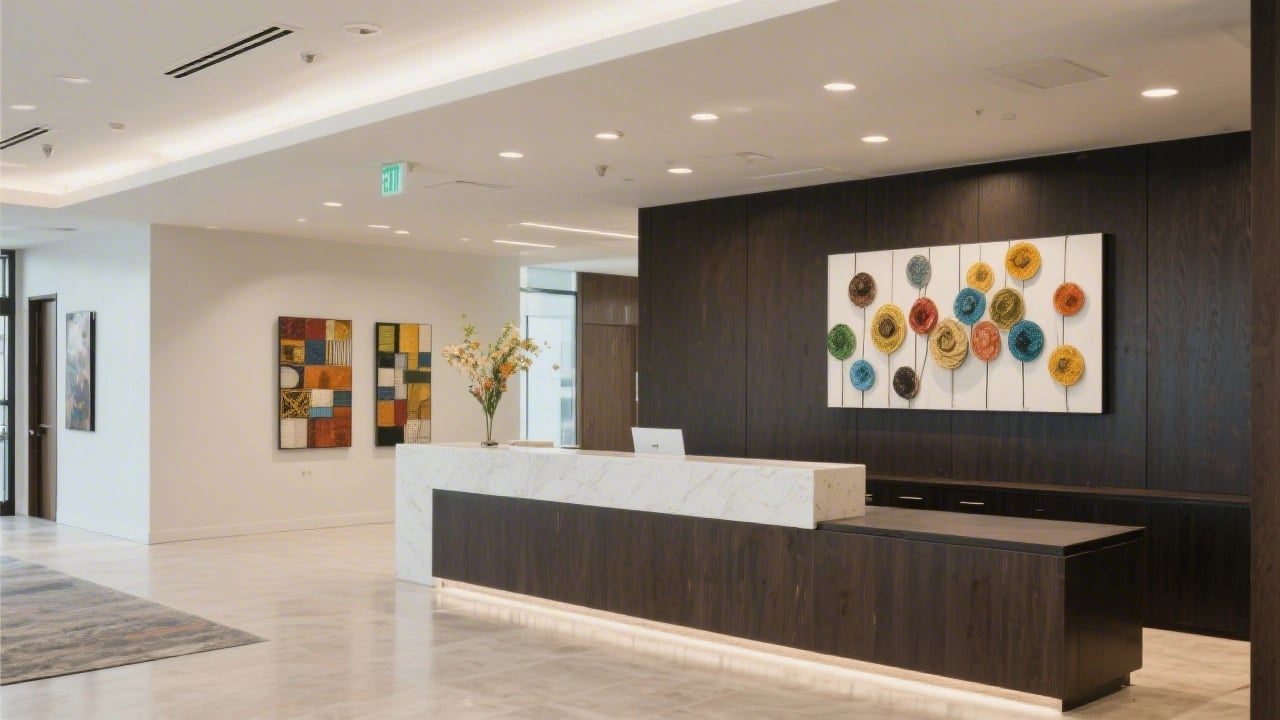
The commercial art sector has witnessed remarkable transformation throughout 2024, driven largely by changing expectations around reception environments. In April 2024, the Australian Commercial Design Awards introduced a new category specifically for “Reception Art Integration,” recognising the growing importance of this design element. The inaugural winner, Sydney interior design studio Bates Smart, created a dynamic reception installation for technology company Atlassian’s Perth office, featuring rotating abstract prints that respond to real-time company data visualisations—a perfect marriage of art and corporate culture.
Simultaneously, the rental and subscription model for corporate art has exploded in popularity. Brisbane-based company Art to Offices reported 215% growth in 2024, now servicing 340 corporate clients across Queensland and New South Wales. Founder Michelle Tang attributes this growth to changing attitudes around capital expenditure and the desire for flexibility. “Businesses are recognising that reception art should evolve with their brand and culture, not remain static for decades,” Tang explained in an October 2024 interview with The Australian Financial Review. Her company now offers quarterly rotation packages, allowing businesses to refresh their reception aesthetic seasonally whilst maintaining tax-deductible operational expenses rather than capital purchases.
The trend towards Australian-made abstract art has accelerated significantly, partly driven by corporate sustainability commitments. In March 2024, the Property Council of Australia released guidelines encouraging members to prioritise locally-sourced artwork as part of broader environmental, social, and governance (ESG) strategies. Major property groups including Dexus and Mirvac have since committed to featuring Australian artists in reception areas across their commercial portfolios. This shift has created unprecedented opportunities for local artists whilst aligning with the cultural authenticity that modern businesses seek to project. Collections like Australian abstract art have seen corresponding demand increases.


Technology Integration and Digital-Physical Hybrids
Perhaps the most intriguing development emerged in August 2024 when Adelaide-based tech company Cohda Wireless unveiled their “Adaptive Reception Canvas” system at the Australian Innovation Festival. This technology combines e-ink displays with traditional framing, allowing businesses to digitally rotate through a curated collection of abstract artworks while maintaining the aesthetic warmth of physical prints. The system can be programmed to display different pieces based on time of day, scheduled client visits, or even weather conditions outside.
While purists debate whether such technology diminishes the authentic art experience, early adopters report significant advantages. Legal firm HWL Ebsworth installed the system in their Adelaide and Canberra offices in October 2024, programming it to display more vibrant, energetic pieces during morning hours and calmer, contemplative works in late afternoon. Reception manager Patricia Nguyen noted that the flexibility allows them to tailor the environment to different client types—displaying bold geometric abstracts when tech clients visit, and softer, more traditional pieces for conservative corporate clients.
Corporate Investment in Art as Strategic Asset
Financial commitment to reception art has reached unprecedented levels across Australian businesses. According to commercial interior fit-out specialists Buildcorp, art now represents 8-12% of total reception renovation budgets in 2024, up from just 3-4% in 2020. Their December 2024 industry report analysed 127 commercial fit-outs completed during the year, finding that average art expenditure in reception areas reached $18,500 for medium-sized businesses (50-200 employees) and exceeded $85,000 for larger corporations (500+ employees).
Tax considerations play a significant role in these investment decisions. Following Australian Taxation Office clarification in May 2024 regarding artwork depreciation for businesses, many companies discovered advantageous write-off opportunities. Artworks under $20,000 can be immediately deducted, while higher-value pieces qualify for depreciation over their effective life. Melbourne accounting firm Hall Chadwick reported a 156% increase in client enquiries about art-related tax deductions in the second half of 2024, indicating growing awareness of these benefits among business owners and CFOs.
Insurance considerations have also evolved. In September 2024, QBE Insurance launched a specialised “Corporate Art Program” specifically designed for commercial reception artwork, acknowledging that standard contents insurance often inadequately covers curated art collections. The product includes public liability coverage for installation, protection against damage during routine cleaning, and importantly, coverage for “brand reputation impact” if artwork is damaged or defaced. This last element recognises that reception art damage can affect business reputation beyond mere replacement costs—a sophisticated understanding of art’s strategic role.
Return on Investment Metrics
Quantifying art’s ROI has long challenged business decision-makers, but 2024 saw several Australian organisations attempt rigorous measurement. In June, Perth-based mining services company Byrnecut conducted a controlled study across two of their office locations. One reception area received a comprehensive art program featuring bold contemporary colour palettes, whilst the other maintained minimal decoration. Over six months, they tracked client feedback, employee surveys, and even tender success rates for clients who visited each location.
The results surprised even advocates. The art-enhanced reception correlated with 12% higher tender success rates, 34% more positive client feedback scores, and notably, 28% higher scores on employee engagement surveys regarding “workplace pride.” While CEO Michael Byrne acknowledged that multiple factors influence these metrics, the correlation was strong enough to justify a $420,000 investment in reception art programs across their remaining 11 Australian offices, completed in November 2024.


Evidence-Based Selection Criteria for Reception Spaces
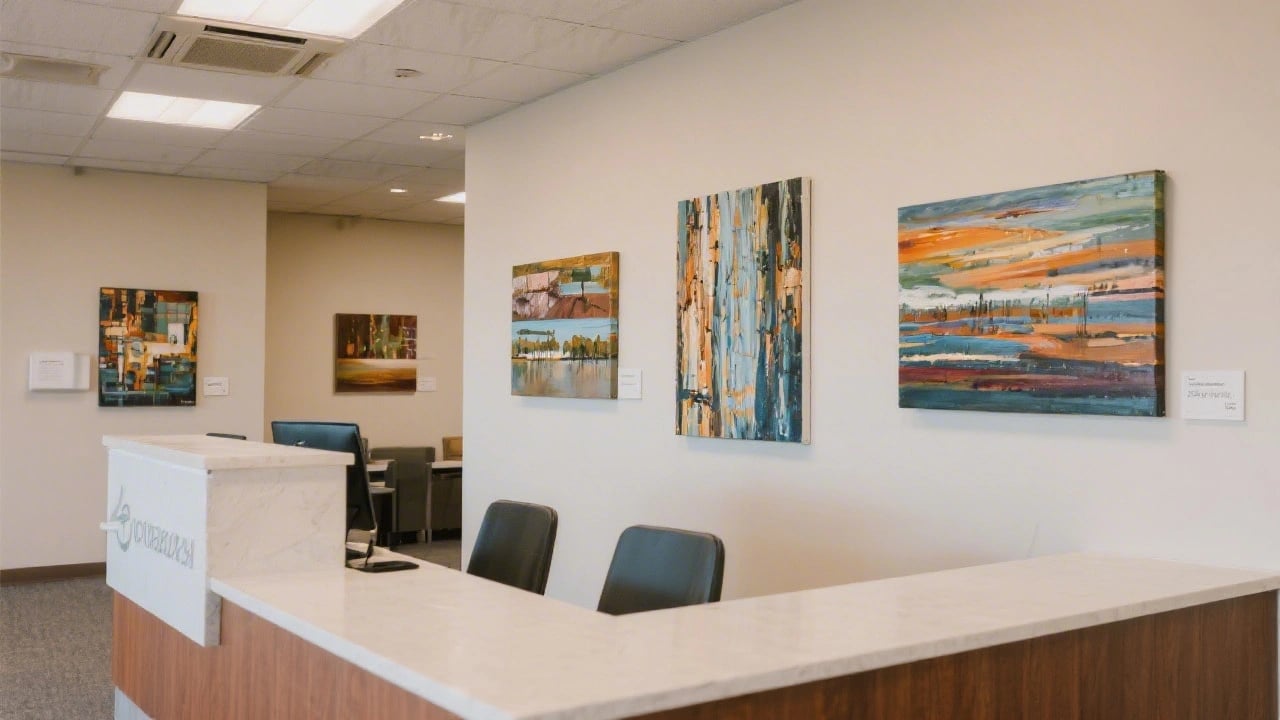
Industry best practices for reception art selection have become increasingly sophisticated and data-driven. In October 2024, the Design Institute of Australia published comprehensive guidelines developed in collaboration with environmental psychologists, professional curators, and business strategists. These guidelines emphasise alignment between art selection and organisational values, recommending that businesses begin with a clear articulation of desired visitor perceptions before considering aesthetic preferences.
Scale remains one of the most common selection errors. The guidelines recommend that primary reception artworks should occupy 50-75% of available wall height and be visible from the entrance threshold. Sydney interior designer Romaine Alwill, whose firm completed 23 commercial reception projects in 2024, notes that businesses consistently underestimate required artwork size. “I’ve had clients select beautiful pieces that simply disappear on a 4-metre wall,” Alwill explained in a November 2024 podcast interview. “The best reception art makes a statement proportional to the space—timidity reads as uncertainty about the business itself.”
Colour strategy has emerged as perhaps the most critical selection criterion, supported by extensive psychological research. The previously mentioned University of Sydney study identified optimal colour approaches for different business types. Professional services firms (legal, accounting, consulting) achieved best results with blue-dominant pieces incorporating geometric elements. Creative industries (advertising, architecture, design) benefited from multi-coloured abstracts with organic forms. Healthcare and wellness businesses saw most positive response to green and blue combinations with flowing, calming compositions. These aren’t rigid rules but evidence-based starting points for selection decisions.
The Abstract Advantage in Professional Contexts
Why has abstract art become the overwhelming preference for reception spaces? Analysis by commercial art consultant Sandra Chen, published in Interior Design Review in July 2024, identifies several compelling factors. Abstract works avoid the literal interpretations that can inadvertently alienate visitors—a landscape might remind someone of a negative experience, a portrait might make visitors uncomfortable with perceived judgment. Abstract pieces offer visual interest and sophistication whilst remaining interpretively neutral, allowing diverse visitors to project their own meanings. This interpretation was supported by research from environmental psychology studies showing universal design principles.
Additionally, abstract art communicates cultural sophistication and contemporary thinking—attributes most Australian businesses wish to project. In an increasingly competitive professional services market, reception environments function as brand manifestos. The decision to feature abstract art signals to visitors that the organisation values creativity, forward-thinking, and cultural engagement. This symbolic communication operates largely at subconscious levels but influences visitor perception nonetheless. For guidance on selecting appropriate styles, many turn to resources like creating visual interest with abstract art.
Artwork featuring bold geometric forms like “Sailboats 044” exemplifies the minimalist retro aesthetic that resonates strongly in professional environments, combining visual sophistication with clean lines that complement contemporary architecture without overwhelming the space.


Australian-Specific Trends and Regional Preferences
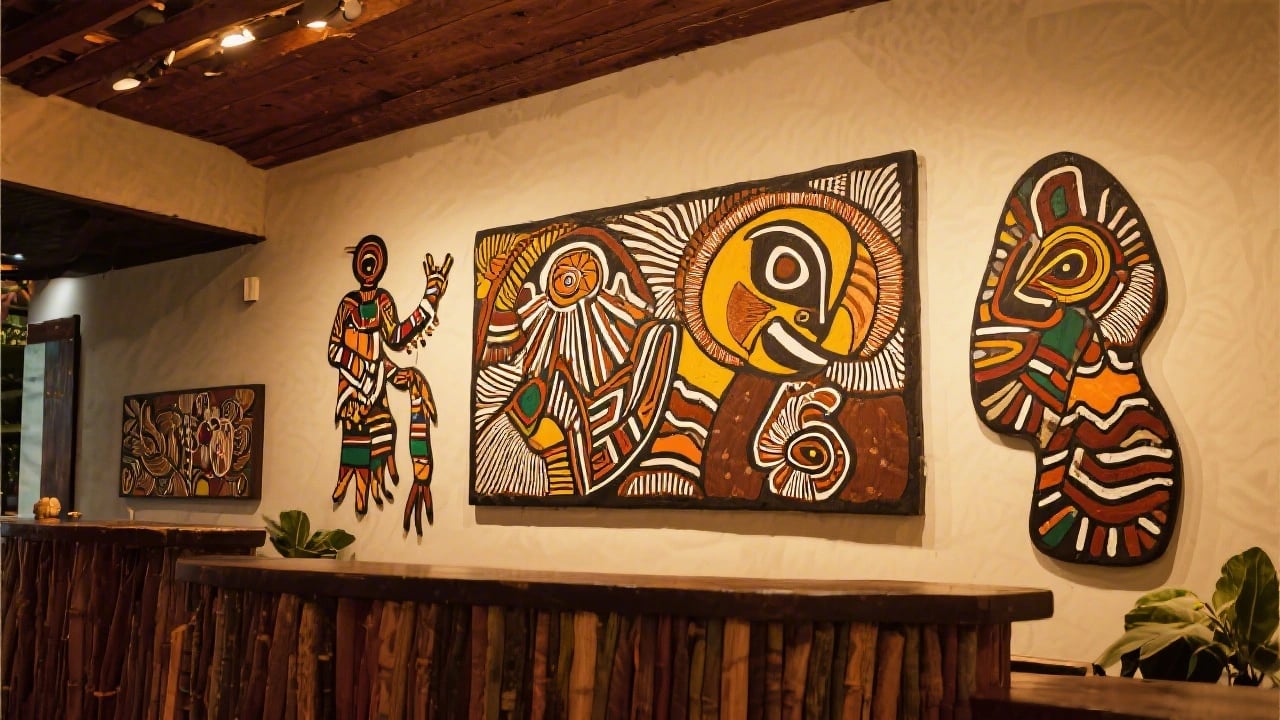
Australia’s reception art trends exhibit fascinating regional variations reflecting local culture and business ecosystems. Research by Sydney-based art consultancy Artify, published in their 2024 Annual Commercial Art Report, analysed 412 corporate reception installations across Australian capital cities, identifying distinct geographical preferences. Sydney businesses showed strongest preference for bold, colourful abstracts (43% of installations), reflecting the city’s confident, outward-facing business culture. Melbourne favoured more subdued, sophisticated pieces with complex layering (38%), aligning with the city’s arts-focused identity.
Brisbane’s commercial art scene has undergone remarkable evolution with preparations for the 2032 Olympics driving significant corporate investment. The city showed the highest growth in abstract art installations throughout 2024, up 67% compared to 2023 according to Queensland Art Gallery’s Commercial Division. Local businesses are increasingly selecting artworks that reference Queensland’s natural environment—coastal abstracts, tropical colour palettes, and organic forms—whilst maintaining professional sophistication. This trend reflects broader efforts to establish distinctive Brisbane business identity separate from southern capitals.
Perth presents unique trends influenced by the resources sector’s dominant economic role. Despite perceptions of conservatism, Perth businesses increasingly favour unexpectedly bold art choices. Mining and resources companies—traditionally risk-averse in aesthetic decisions—now lead in commissioning striking abstract installations. In August 2024, Fortescue Metals Group unveiled a spectacular 8-metre abstract commission by Perth artist Philippa Nikulinsky in their newly renovated reception, featuring dynamic forms in the company’s green and blue brand colours. CEO Fiona Hick explained the decision as deliberately signalling the company’s transformation from traditional mining toward renewable energy leadership.
The Coastal Abstract Phenomenon
Across all Australian cities, coastal and beach-inspired abstracts have emerged as the single most popular reception art category in 2024. This trend transcends geographical proximity to actual coastline—landlocked businesses in Western Sydney and outer Melbourne suburbs embrace coastal abstracts as enthusiastically as beachside companies. Cultural analyst Dr Brendan Thompson, speaking at the Australian Design Conference in November 2024, attributed this phenomenon to deeply embedded aspects of Australian identity and the psychological associations between coastal environments and positive emotional states.
Commercial art suppliers report that coastal abstracts communicate approachability and relaxation whilst maintaining professional sophistication—a difficult balance that makes them versatile across business types. Moreover, Australia’s strong coastal tourism associations mean these artworks can subtly signal Australian identity to international visitors without resorting to clichéd koala or opera house imagery. The sophistication of contemporary coastal abstracts allows businesses to celebrate Australian identity through refined, internationally-credible aesthetics. Collections focusing on beach and coastal wall art have seen remarkable commercial uptake.


Implementation Strategies from Leading Organisations
Successful reception art programs require more than selecting attractive pieces—implementation methodology significantly impacts outcomes. In February 2024, Melbourne-based change management consultancy Nous Group published case studies examining art implementation processes at twelve Australian organisations. Their research identified common success factors including employee involvement in selection, clear connection to organisational values, and thoughtful installation that considers lighting, sightlines, and integration with existing architectural elements.
The most successful implementations treated art selection as strategic communications projects rather than facilities management tasks. National Australia Bank’s approach exemplifies this methodology. For their 2024 reception renovations across 34 branches, NAB formed selection committees including branch managers, customer experience representatives, and local community members. Each location selected artworks reflecting their specific community whilst maintaining brand consistency through standardised framing and presentation approaches. The program, completed in September 2024, received the Australian Banking Association’s Innovation in Customer Experience Award, specifically citing the locally-responsive art program as a differentiating factor.
Professional installation quality has become non-negotiable for serious reception art programs. In July 2024, commercial insurance claims data revealed that 23% of damaged corporate artworks resulted from inadequate installation rather than accidents or vandalism. This finding prompted many businesses to engage specialist art handlers rather than general contractors. Brisbane company Art Hang, which exclusively provides corporate art installation services, reported 340% revenue growth in 2024, completing 827 commercial installations compared to 243 in 2023. Their success reflects growing recognition that professional installation protects both artwork investment and safety liability.
Maintenance and Longevity Considerations
Reception environments present unique challenges for artwork longevity due to high-traffic, variable lighting, and environmental factors. The Australian Institute for the Conservation of Cultural Material released updated guidelines in March 2024 specifically addressing commercial reception artwork preservation. Key recommendations include UV-filtering glazing for all pieces, quarterly professional cleaning protocols, and environmental monitoring to track temperature and humidity fluctuations that can damage artworks over time.
Framing choices significantly impact both aesthetic presentation and preservation outcomes. The trend toward float-mounting under museum-quality anti-reflective glass has accelerated in 2024, with this presentation style appearing in 64% of high-end commercial installations according to Sydney framing specialist Framed. While initial costs exceed basic framing by approximately 40%, the superior visual presentation and protection justify investment for significant reception installations. Moreover, proper framing communicates respect for the artwork itself—a subtle signal about organisational attention to quality and detail that visitors absorb subconsciously.
Looking forward, several emerging trends appear positioned to reshape reception art strategies. Artificial intelligence curation tools are beginning to influence selection processes, with several Australian startups developing algorithms that match artwork to brand values, architectural styles, and psychological objectives. Additionally, augmented reality preview tools allowing businesses to visualise artworks in their actual spaces before purchase have become standard offerings from commercial art suppliers, significantly reducing selection uncertainty and returns. For broader context on transforming workspace environments, see guidance on transforming office walls into art.
The convergence of evidence-based psychological research, sophisticated measurement methodologies, and growing business recognition of environmental impact on stakeholder perception has elevated reception art from decorative afterthought to strategic asset. As Dr Sarah Tennant’s ongoing research continues revealing the neurological mechanisms through which visual environments shape human perception and behaviour, business investment in reception aesthetics will likely intensify further. The organisations leading this transformation aren’t merely decorating walls—they’re strategically shaping the critical first impressions that influence client relationships, employee pride, and ultimately, business outcomes. For those seeking to enhance their spaces, exploring quality art prints provides accessible entry points to this strategic approach, whilst understanding principles discussed in abstract art accent guides ensures cohesive implementation across broader workplace environments.
 | Joseph Russell Joseph is an Australian abstract artists and curator of the Inomaly art collection. |