
In 1915, Russian artists stopped painting pictures and started building with steel. Vladimir Tatlin rejected canvas entirely, assembling metal and glass into three-dimensional structures that looked more like industrial prototypes than fine art. This wasn’t a passing aesthetic preference—it represented a fundamental belief that art should abandon decoration and serve society through practical design. That conviction became constructivism, a movement that redefined what artists could do and who they served. Born from revolutionary idealism, constructivism didn’t just create beautiful objects; it built a new visual language that would influence architecture, graphic design and industrial production for generations.
The constructivism art movement championed functionality, abstraction and the marriage of art with industrial production. Its pioneers believed art should serve society by creating objects and environments that improved daily life. This philosophy gave birth to numerous sub-movements and interpretations across different countries, each adapting constructivist principles to their cultural context whilst maintaining the core commitment to geometric forms, rational composition and socially engaged practice. The movement’s influence extends far beyond its historical moment, continuing to inspire contemporary artists and designers who value clarity, structure and purposeful creation.
1. Russian Constructivism: The Original Revolution
Russian Constructivism emerged between 1915 and 1920 as artists responded to the upheaval of revolution. Vladimir Tatlin, Alexander Rodchenko and Lyubov Popova rejected traditional easel painting, instead creating three-dimensional assemblages from industrial materials such as metal, glass and wood. They viewed themselves as ‘artist-engineers’ whose work should serve the new Soviet society through practical design applications.
The movement’s defining characteristics included dynamic diagonal compositions, bold typography and a limited colour palette dominated by red, black and white. Constructivists designed everything from propaganda posters to workers’ clubs, theatre sets to textiles. Their commitment to functionality over decoration fundamentally challenged Western notions of fine art’s purpose and value. This utilitarian approach resonates in modern abstract art that prioritises structure and form, with bold geometric compositions echoing constructivism’s emphasis on clear lines and purposeful design.
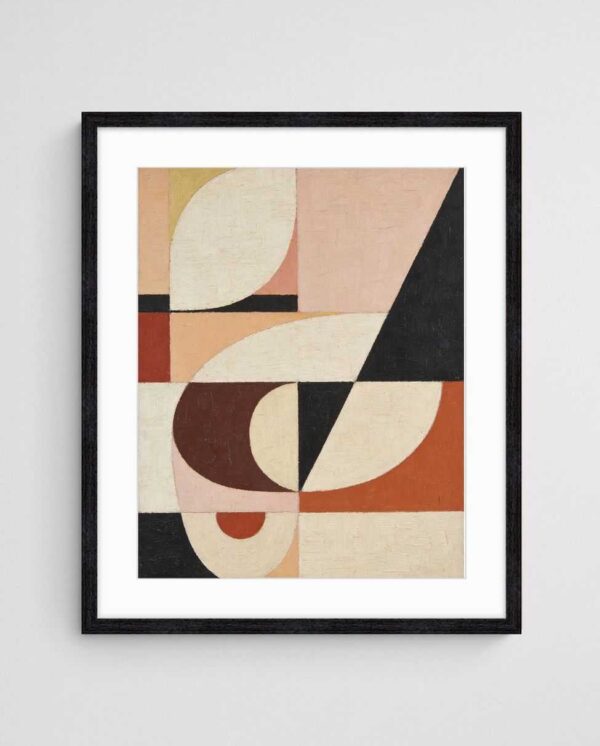
The visual language Tatlin and his peers developed appears in contemporary pieces like “Sailboats 042 – Bold Geometric Abstract Art Print,” which captures that revolutionary spirit through structured composition and industrial clarity.
Soviet authorities suppressed the movement by the 1930s, viewing its experimental nature as incompatible with Socialist Realism. Many constructivists fled abroad or redirected their talents toward production design. Despite this truncation, the movement’s influence had already spread internationally, seeding new approaches across Europe and beyond.
2. International Constructivism: Spreading the Vision
As constructivist ideas migrated westward, they evolved to suit different cultural contexts. In Germany, the Bauhaus school integrated constructivist principles into comprehensive design education. In the Netherlands, artists developed their own geometric abstraction movements. Hungary and Poland fostered vibrant constructivist scenes that balanced revolutionary ideals with local aesthetic traditions.
International Constructivism maintained the core commitment to geometric forms and rational composition whilst sometimes allowing more decorative or expressive elements. László Moholy-Nagy experimented with photography and light installations, expanding constructivism beyond physical assemblage. This cross-pollination enriched the movement, demonstrating that its principles could adapt whilst retaining fundamental integrity.
Key Characteristics of International Constructivism
- Integration with architecture and industrial design practices
- Emphasis on typography and graphic communication
- Experimentation with new media including photography and film
- Collaborative workshops blending art, craft and manufacturing
The movement’s international spread created a network of artists who shared ideas through exhibitions, manifestos and design journals. This collaborative spirit anticipated today’s global art dialogue, where influences flow freely across borders. Those interested in how such historical movements continue to shape contemporary practice might explore our guide to identifying different abstract styles.
3. Kinetic Constructivism: Art in Motion
Kinetic Constructivism emerged in the 1920s when Naum Gabo and Antoine Pevsner began creating sculptures that incorporated actual or implied movement. Their 1920 Realistic Manifesto argued that kinetic rhythms should replace static forms, introducing time as a fourth dimension in sculptural work. This expanded constructivism’s possibilities beyond fixed geometric arrangements.
These pioneers constructed works using transparent materials and motorised elements that created shifting visual relationships as viewers moved around them. The emphasis shifted from solid mass to spatial relationships, from weight to lightness, from permanence to transformation. This approach influenced subsequent generations of artists working with kinetic and optical art movements.
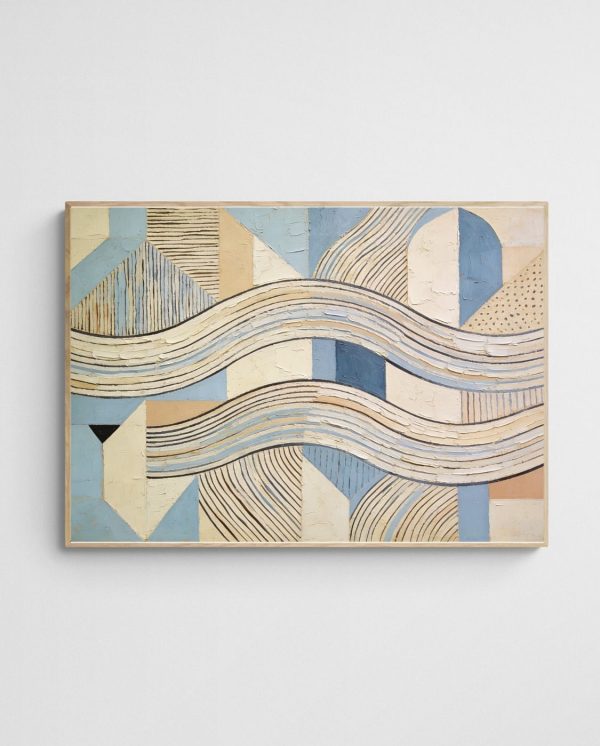
Contemporary interpretations of kinetic principles appear in static works that suggest movement through dynamic composition. The rhythmic patterns in “Waves of Harmony – Coastal Geometric Abstract Art Print” capture this sense of visual flow, translating kinetic energy into two-dimensional form whilst maintaining constructivism’s geometric rigour.

By making the viewer’s movement essential to experiencing the work, kinetic constructivists challenged passive contemplation and engaged audiences as active participants in creating meaning. This principle anticipated interactive and installation art practices that remain central to contemporary practice.
4. Geometric Abstraction: Pure Form and Colour
Geometric Abstraction developed alongside constructivism, sharing its commitment to non-representational forms whilst often diverging in philosophy. Where constructivism emphasised utility and social purpose, geometric abstraction pursued aesthetic purity for its own sake. Piet Mondrian and Kazimir Malevich stripped visual language down to its essential elements—line, shape and colour—creating compositions of remarkable simplicity and power.
This branch explored how basic geometric forms could generate complex emotional and spiritual responses. The precision required in balancing shapes, proportions and colour relationships demanded both mathematical rigour and intuitive sensitivity. Geometric abstraction became a meditation on visual fundamentals, revealing how much meaning could emerge from minimal elements.
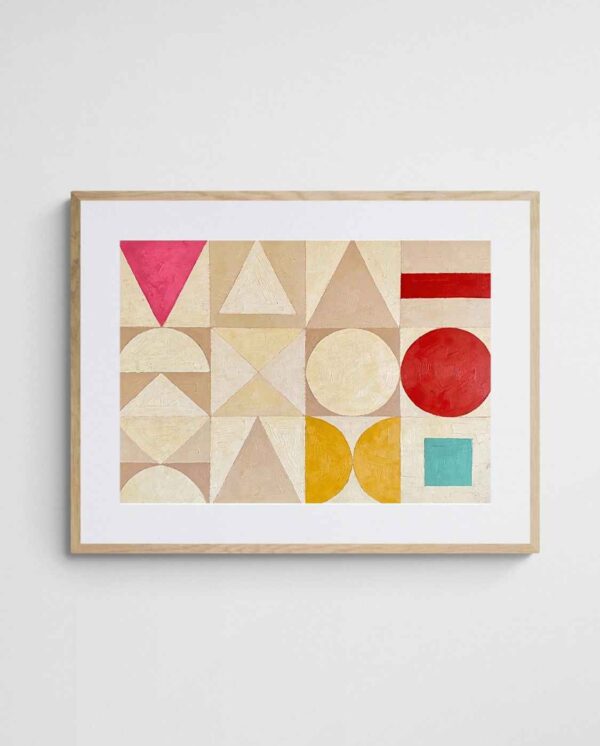
The movement’s influence permeates contemporary design. Today’s geometric abstract prints continue this tradition, with pieces like “Checkerboard Future – Minimalist Geometric Abstract Art Print” demonstrating how geometric precision creates sophisticated visual impact without representational content. The emphasis on colour relationships informs current interior design practices, as explored in colour balance strategies for modern spaces.
5. Concrete Art: Mathematical Precision
Concrete Art, theorised by Theo van Doesburg in 1930, took geometric abstraction to its logical extreme. Van Doesburg argued that art should not abstract from nature but instead create entirely new realities using only concrete, measurable elements. This meant rejecting any symbolic or representational content, allowing forms to exist purely as themselves—colour as colour, line as line, shape as shape.
Max Bill and other concrete artists developed systematic approaches using mathematical principles, modular units and logical progressions. Their works often followed predetermined rules or algorithms, anticipating computational art by decades. This systematic methodology distinguished concrete art from more intuitive forms of abstraction, positioning it as a rational, almost scientific practice.
Principles of Concrete Art
- Complete rejection of naturalistic or symbolic reference
- Use of mathematical or systematic compositional methods
- Emphasis on clarity, precision and objective execution
- Exploration of serial variations and modular structures
The movement flourished particularly in Switzerland, Brazil and Argentina, where artists formed collectives dedicated to concrete principles. These groups published manifestos, organised exhibitions and engaged in vigorous theoretical debates about art’s nature and purpose. Their intellectual rigour elevated abstract art from decorative practice to philosophical investigation.

Minimalist aesthetics today owe considerable debt to concrete art’s disciplined approach. The movement demonstrated that reducing visual elements to their essence could produce works of surprising complexity and beauty, a lesson that continues to inform contemporary design thinking.
6. Neo-Constructivism: Contemporary Interpretations
Neo-Constructivism emerged in the 1980s and 1990s as artists rediscovered and reinterpreted constructivist principles for contemporary contexts. Working in a post-industrial, increasingly digital world, neo-constructivists found value in constructivism’s formal vocabulary and commitment to engaging social realities through art practice, though without early constructivism’s utopian confidence.
Contemporary artists adopting neo-constructivist approaches often incorporate industrial materials, modular systems and collaborative production methods. However, they typically approach these strategies with irony or critical distance, acknowledging that art’s relationship to social transformation has become more complex. This reflexive stance distinguishes neo-constructivism from its optimistic antecedent.
The movement expanded to include diverse media including installation, video and digital art. Artists explored how constructivist principles might address contemporary issues like globalisation, technology and environmental sustainability. Neo-constructivist influence appears throughout contemporary design, from architecture to abstract art prints that bring structured composition into modern interiors. The approach’s emphasis on clarity and purpose aligns well with current preferences for functional, uncluttered spaces. Those seeking to understand broader contemporary movements might explore why contemporary artists continue embracing abstraction.
7. Digital Constructivism: Technology Meets Theory
Digital Constructivism represents the latest evolution, as artists apply constructivist principles using computational tools and algorithmic processes. Software enables precise geometric manipulation, infinite colour possibilities and systematic variations that early constructivists could only achieve through painstaking manual labour. Contemporary digital artists create works using parametric design, generative algorithms and data visualisation techniques that echo concrete art’s systematic methodologies.
The computer becomes both tool and collaborator, executing logical operations that produce unexpected visual results. This human-machine partnership updates constructivism’s artist-engineer ideal for the 21st century. Digital fabrication technologies like 3D printing and laser cutting enable artists to realise constructivist sculptural visions with unprecedented precision and efficiency, resurrecting constructivism’s original ambition to bridge art and manufacturing.
Digital constructivism’s influence extends beyond fine art into user interface design, data visualisation and architectural rendering. The movement’s principles inform how we organise visual information across digital platforms, making constructivist thinking more pervasive than ever. The accessibility of digital tools has democratised constructivist approaches, allowing artists worldwide to experiment with geometric abstraction and systematic composition. For those interested in how technology reshapes artistic practice, post-digital art developments offer fascinating perspectives.
Comparing Constructivism Art Movements
| Movement | Time Period | Core Principle | Key Innovation |
|---|---|---|---|
| Russian Constructivism | 1915-1930s | Art serves social utility | Industrial materials in fine art |
| International Constructivism | 1920s-1940s | Geometric form adapts culturally | Cross-border artistic exchange |
| Kinetic Constructivism | 1920s-1960s | Movement creates meaning | Time as sculptural dimension |
| Geometric Abstraction | 1910s-present | Pure form and colour | Spiritual through minimal means |
| Concrete Art | 1930s-1960s | Mathematical precision | Systematic compositional rules |
| Neo-Constructivism | 1980s-present | Critical reinterpretation | Reflexive social engagement |
| Digital Constructivism | 1990s-present | Algorithmic creation | Computational collaboration |
Bringing Constructivism Home
Constructivism works in interiors because its principles solve real design problems. Geometric clarity organises visual space. Purposeful composition prevents clutter. Structural integrity makes abstract work feel intentional rather than random. Whether you’re drawn to the revolutionary boldness of Russian Constructivism or the mathematical precision of Concrete Art, these movements offer proven approaches to creating spaces that feel both cohesive and dynamic.
When selecting geometric abstract works for your space, look for pieces that demonstrate formal relationships rather than relying on representation. The interplay of shapes, the balance of positive and negative space, and the rhythmic repetition of elements all contribute to compositions that remain engaging over time. This enduring quality makes constructivist-inspired works effective for both residential and commercial environments.
Explore our curated collections to discover how constructivist principles continue inspiring contemporary artists. From bold geometric statements to subtle minimalist compositions, these works demonstrate that constructivism’s revolutionary vision remains vital and relevant.
 | Joseph Russell Joseph is an Australian abstract artists and curator of the Inomaly art collection. |